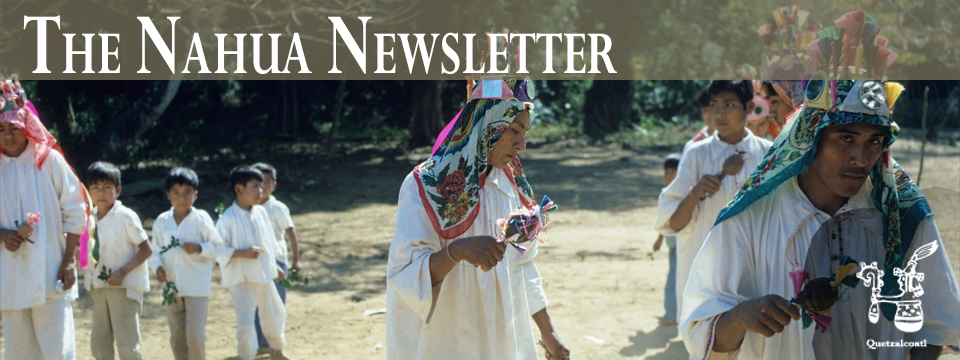
Editor’s note: This content is archival.
Nahua Newsletter
February 1996, Number 21
 The Nahua Newsletter
With support from the Department of Anthropology
Indiana University-Purdue University Fort Wayne
A Publication of the Indiana University
Center for Latin American and Caribbean Studies
Contents
- Nahua Newsletter News
- News Items
- Book Reviews
- Bloodsucking Witchcraft: An Epistemological Study of
Anthropomorphic Supernaturalism in Rural Tlaxcala. By Hugo G. Nutini and Jack M.
Roberts. Tucson: University of Arizona Press, 1993. Pp. xxii+476. $43.95 (cloth).
ISBN 0-8165-1197-7. Reviewed by Barry L. Isaac. - Images from the Underworld: Naj Tunich and the Tradition
of Maya Cave Painting. By Andrea Stone. Austin: University of Texas Press, 1995.
Pp.x+284. $45.00 (cloth). ISBN 0-292 75552-X. Review by Gordon Brotherston. - Native Artists and Patrons in Colonial Latin America.
Edited by Emily Umberger and Tom Cummins. Phoebus: A Journal of Art History, Vol. 7.
Tempe: Arizona State University, 1995. Pp. 126. $15.00. Reviewed by Norman W.
Bradley. - Las Lenguas indigenas mesoamericanas. By Jorge A. Suarez.
Mexico D.F.: Instituto Nacional Indigenista, Centro de Investigaciones y Estudios
Superiores en Antropologia Social, 1990 [1983]. Pp. xvi+325. ISBN 968-496-219-3.
Reviewed by David Shaul. - Adaptacíon y resistencia en el Yaquimi: Los Yaquis
durante la colonia. By Evelyn Hu-DeHart. Translation by Zulai Marcela Fuentes Ortega;
Revised by Teresa Rojas Rabiela. Historia de los pueblos indígenas de
México. México, D.F.: Centro de Investigaciones y Estudios Superiores
en Antropología Social, Instituto Nacional Indigenista, 1995. Pp. 124. ISBN
968-496-264-9. Reviewed by Gregory F. Truex.
Entre el desierto y la sierra: Las naciones o’odham y
tegüima de Sonora, 1530-1840. By Cynthia Radding. Historia de los pueblos
indígenas de México. México, D.F.: Centro de Investigaciones y
Estudios Superiores en Antropología Social, Instituto Nacional Indigenista,
1995. Pp. 213. ISBN 968-496-264-9. Reviewed by Gregory F. Truex. - Our Lady of Guadalupe: Faith and Empowerment among
Mexican-American Women. By Jeanette Rodriguez. Austin: University of Texas Press,
1994. Pp. xv+227. $35.00 (cloth). ISBN 0 292-77061-8. $13.95 (paper). ISBN
0-292-77062-6. John M. Ingham. - The Covenants with Earth and Rain: Exchange, Sacrifice,
and Revelation in Mixtec Sociality. By John Monaghan. Norman: University of Oklahoma
Press, 1995. Pp. xvi+394. $42.95 (cloth) ISBN 0-8061-2762-7. Reviewed by Alan R.
Sandstrom. - In the Realm of Eight Deer: The Archaeology of the Mixtec
Codices. By Bruce E. Byland and John M. D. Pohl. Norman: Univ. of Oklahoma Press,
1994. Pp. xx+292. $65.00 (cloth). ISBN 0 8061-2612-4. Byron E. Hamann. - Our Lady of Guadalupe: The Origins and Sources of a
Mexican National Symbol, 1531-1797. By Stafford Poole, C.M. Tucson: University of
Arizona Press, 1995. Pp. 325. $19.95 (paperback). ISBN 0-8165-1526-3. Reviewed by
Eileen M. Mulhare. - Maya Resurgence in Guatemala: Q’eqchi’ Experiences. By
Richard Wilson. Norman: University of Oklahoma Press, 1995. Pp. xiv+373. $32.95
(cloth). ISBN 0-8061-2690-6. Cindy Vandenbergh Hull. - Commentary
- Illustrations in this Issue
- Directory Updates
Nahua Newsletter News
Welcome to the Nahua Newsletter, now beginning its eleventh year of publication in
the interest of scholars and students of Nahua culture, history, and language. In this
issue you will find news items, announcements, requests for information, a list of used
books available, book reviews, and an update of the subscriber directory. It was the
editor’s intention to reprint the entire directory in this issue so that readers could
have an updated list of subscribers’ addresses. However, so many book reviews have been
submitted that I am obliged to put off publishing the subscriber list until a future
issue.
Interest continues to be strong in the NN and readers from a number of countries
have written to express their enthusiasm for the publication. The original intent of
the newsletter was to give researchers working in non-Maya areas of Mexico a means to
communicate with each other and to create a sense of community and common cause. These
researchers sometimes felt isolated with so much professional and media attention being
paid to the Maya region. We welcome Mayanists as subscribers, of course, who may want
to keep abreast of developments in other areas of Middle America.
The financial status of the NN continues to be precarious. It costs about $700
(U.S.) per year to print and mail out two issues. Over the past ten years the generous
donations of readers have made possible the publication of the NN. Your remarkable show
of support is very impressive by any standard! In addition, we received a small grant
from Indiana University International Programs that helped keep us solvent for a year
and a half. The ideal solution to our financial insecurities would be for the NN to be
adopted in the budget of a Latin American studies program or a foundation that
specializes in Native American or Latin American studies. We will continue to search
for an appropriate organization to underwrite our efforts. In the meantime, we are
applying for grants to help assure the future of the newsletter. If you find the NN to
be of use in your work or simply as a means to keep up to date, please continue to
forward donations to the address below. All money is used for printing and mailing –
there are absolutely no administrative costs associated with publishing the
newsletter.
Several readers have asked what an appropriate donation might be. There is no easy
answer because giving money to the NN is strictly voluntary. Donations have ranged from
$5.00 to $100.00 (U.S.) with the average being about $20.00. Any amount helps. The
editor has set up a special account at Indiana University-Purdue University Fort Wayne
to receive donations for the newsletter. Checks or money orders should be made out to
“Nahua Newsletter.”
Please forward news, announcements, requests for assistance, comments, or donations
to:
News Items
(1) Received from Hedda Scherres: In the last issue of the NN, Hugo Nutini was
asking for examples of what the Nahuas call themselves in the different parts of
Mexico. As I am currently conducting field research in the Montaña baja of the
state of Guerrero, I will offer readers some observations that I have been able to
make. I discussed my findings with Vital Alonso, a Mexican colleague and Nahuatlato of
the region.
As in the Tlaxcala region, the term Mexicano is used in the Chilapa region to refer
to the Nahuatl language and not to the people who speak it. Nowadays, as education is
increasing and the children are taught in their indigenous language, some villagers
know the term Nahuatl. If they are familiar with the term, they prefer to use it to
name their language. The mestizos of Chilapa call Nahuas of the region Mexicaneros. But
there is no term of self-reference in any of the Nahua populations of the region.
Identification at the village level is very strong and people will tell you they are
Acateco, Atzacualoyero, etc., and then explain how their dialect differs from that
spoken in other villages. In former times, the term masehual was common as a term of
self-reference as an Indian, but its use has nearly disappeared.
When the Nahuas of the Chilapa region want to distinguish themselves from Indians of
other languages, they name these languages and add the word popoloca. They say, for
example, Tlapanec Popoloca and one commonly hears the phrase Mixtec Popoloca. In former
times, non Indian males were called coyotl and in Acatlan they were also named with the
Nahuatl pronunciation of the term Christiano, kixchano. For women, they used the word
xinolla throughout the entire region, which I believe is their attempt to pronounce the
Spanish word señora. These expressions are still used by older people but others
use them to mock foreigners.
Correspondence should be sent (until September 1996) to Hedda Scherres at Lista de
Correos, 41100 Chilapa, Guerrero, México. If other NN readers would like to
continue this discussion, please mail your remarks to the editor for inclusion in the
next issue.
(2) The editor would like to announce a major event in Mesoamerican scholarship that
should be of interest to all readers. Guy Stresser-Péan has just published a
facsimile and detailed analysis of a 16th-century codex that he and his wife Claude
discovered in the Sierra Norte de Puebla in 1991. The couple was engaged in
ethnographic research in the Huauchinango Xicotepec region when Nahua villagers
informed them of the manuscript’s existence. The codex, which is 6.36 meters long and
made from parchment, was kept by villagers who believed the document to be a record of
land titles. The document, that Stresser-Péan calls the Códice de
Xicotepec, was in the style of the Acolhuas whose capital was Texcoco. Events depicted
in the Codex cover a period of time from 1431-1533 and the document appears to have
been painted between 1564 and 1576.
Stresser-Péan has published his analysis of the manuscript in both a French
and Spanish edition. The beautifully done facsimile and the lavish, quarto-sized book
containing the analysis were published jointly by the Gobierno de Estado de Puebla, the
Centro Francés de Estudios Mexicanos y Centroamericanos, and the Fondo de
Cultura Económica in 1995. The codex fills an important gap in the historical
record and provides invaluable information on relations between the capitals of the
Triple Alliance and the provinces. The Stresser-Péans are to be congratulated
for this magnificent discovery and for the truly excellent work in analyzing the
manuscript. (Yolotl Gonzales of INAH has agreed to write a review of the Códice
de Xicotepec for the NN that will appear in an upcoming issue.)
(3) Susan Gillespie writes to announce: Illinois Studies in Anthropology is a
monograph series published since 1961 by the University of Illinois Press under the
editorial direction of faculty in the Anthropology Department. The series welcomes
manuscripts relating to all subfields of anthropology. To date, it is strongest in
Latin American and Asian ethnography, but the directors encourage the submission of
scholarly work that bridges or goes beyond traditional subfields, including
ethnohistory. For more information, contact Dr. Susan Gillespie, Publications Committee
Chair, Department of Anthropology, University of Illinois, 109 Davenport Hall, 607 S.
Mathews, Urbana, IL 61801 USA.
(4) Brad Huber writes: Robert Anderson, a physician-anthropologist from Mills
College, and I have written an article entitled “Bonesetters and Curers in a Mexican
Community: Explanatory Models, Status, and Gender.” It will appear in Medical
Anthropology 17(1).
In March 1996, I will be interviewing for the second time 10 Nahuat-speaking
midwives from the Sierra Norte de Puebla. I am currently developing questions for the
interview. If there are some burning issues readers would like me to discuss with these
midwives, they should feel free to write me at the College of Charleston. The complete
address is Department of Sociology and Anthropology, College of Charleston, Charleston,
SC 29424.
(5) John Schwaller writes that the Nahuat-L electronic discussion list has moved.
The new list address (where messages you post will be distributed to the whole group)
is:
nahuat-l@listserv.umt.edu
To subscribe, send this message:
subscribe nahuat-l John Doe [substitute your name]
to the listserv address:
listproc@listserv.umt.edu
(6) New application deadline for The Foundation for the Advancement of Mesoamerican
Studies, Inc., has been announced: please have materials submitted by September 30,
1996.
The Foundation was formed in 1993 to foster increased understanding of ancient
Mesoamerican cultures and aims, by hosting an annual grant competition, to assist and
promote scholars who might otherwise be unable to complete their programs of research
and synthesis.
The Foundation grants are awarded to the most well-qualified scholars regardless of
degree level. However, preference is for non-academic professionals, recent graduates,
and degree candidates who are currently involved in fully-developed programs of study
and/or research. Other qualifications being equal, preference is given to candidates
who have not had extensive prior opportunity for grant-supported research of ancient
Mesoamerican cultures, and to candidates whose projects have the most likelihood of
achieving new understandings and/or wide institutional and geographic interest.
Send inquiries to: Foundation for the Advancement of Mesoamerican Studies, Inc., 268
South Suncoast Boulevard, Crystal River, Florida 34429 / Fax: (352) 795-1970 / e-mail:
famsifl@aol.com
(7) Paul Proulx writes: In recent months I have been collecting etymologies for kin
terms (“my wife,” “my woman,” etc.). Common etymologies are “old man,” “old woman,”
“man,” “woman,” as well as descriptive terms. I am looking for underlying rules of kin
term innovation and their social causes. I have Merrifield’s book on Proto Otomanguean
Kinship, but otherwise have little from Mexico. I would welcome communication with
anyone with information on particular languages. Send correspondence to: Paul Proulx,
Box 111, Heatherton, NS BOH 1RO, CANADA.
(8) Cecelia Klein has sent along the following announcement: On Saturday, March 2,
1996, the UCLA Department of Art History will hold a symposium on “What Rituals Did:
Mexico and Peru, 1200-1700.” The symposium has been organized by Cecelia Klein of the
Department of Art History at UCLA and will be held in 3273 Dickson from 9:00 a.m. to
5:00 p.m. It will be free and open to the public. The speakers and their paper titles
are:
Cecelia Klein, Department of Art History, UCLA, “Introduction.”
Richard C. Trexler, Department of History, State University of New York at Binghamton,
“From Tension to Torpor: Reifying the Ritual Record.”
John Pohl, Fowler Museum of Culture History, UCLA, “The Social Context of Art and
Ritual at Tizatlan and Ocotelolco.”
Elizabeth H. Boone, Department of Art, Tulane University, “What it Takes to Make a
Place: Aztec and Mixtec Foundation Rituals.”
John Ott, Department of Art History, UCLA, “Courses of Empire” The Politics of Water
Rituals in the 15th-Century Valley of Mexico.” Johanna Broda, Instituto de
Investigaciones Historicas, UNAM, “Rain, Rocks, and Air: An Anthropological Analysis of
Tlaloc Rituals and Political Power Before and After the Conquest.”
Jeanette Facrot Peterson, Department of Art, University of California, Santa Barbara,
“Ritual Warfare: Defining Alterity in Pre- and Post-Conquest Mexico.”
Tom Cummins, Art Department, University of Chicago, “The Elementary Structures of
Religion and Andean Kinship: Pérez Bocanegro’s Ritual formulario.”
Carolyn Dean, Porter College, University of California, Canta Cruz, “Going Wild:
Chunchos Dances in Colonial Peru.”
(9) Elena Limón of the Universidad de las Américas writes: Ya
apareció el volumen 5 de las obras de Robert H. Barlow, editadas por
Jesús Monjarás, Elena Limón y María de la Cruz
Paillés, INAH-UDLA, México, 1994. Se titula: Fuentes y estudios sobre el
México indígena. Primera parte: Generalidades y Centro de México.
Contiene una interesante serie de artículos referentes a códices,
además de otros trabajos sobre documentos de J.F. Ramírez, la
colección Boturini, la Biblioteca Bancroft, etc.
(10) From Mexico an important request from Antonio Gatica Santiago: Hubo una persona
quien me comentó que usted podria ayudarme para sacar adelante un trabajo que
estoy realizando para un grupo de niños que inician el mundo de las
matemáticas en este su primer año de instrucción primaria. La
diferencia del hecho educativo estriba en que las matemáticas se empiecen a dar
en su propria lengua. Y los que hasta estos momentos me detiende es que nombre
asignaste a las siguientes figuras:
cilindro milmiltik
esfera tolontik
cono ?
cubo ?
cuadrado ?
triangulo ?
rectángulo ?
Si tuviera usted material que me permitieran conocer las nombres de estas figuras en
lengua náhuatl, se lo agradeceria infinitamente, ya que este me permitiria dar
continuidad a lo iniciado en estos rincones del Estado de Guerrero. En espera de poder
contar con su ayuda, me despido con la alegria de saber que a distancia hay alguien que
se intereza por lo que es mio. Escribir a: Antonio Gatica Santiago, Calle 24 Sur #167,
Chilapa, Guerrero 41100 MEXICO / tel. 91 (747) 5-12-86.
(11) The Brooklyn Museum is sponsoring a film festival called “Self Discoveries: A
Festival of Latin American Cinema” from March 8 to April 21, 1996. The screening at 7
p.m. on opening night will be a film entitled “In Necuepalizili in Aztlan” (“Return to
Aztlan”) and it is entirely in Nahuatl with English subtitles. The write up describes
the movie as “a sensuous, stunning re-creation of Aztec society, using the music, art,
dress, and customs of that remarkable civilization.” The guest speaker at the opening
will be Juan Mora Catlett who directed the film.
(12) Philip Arnold has published an article entitled, “Paper Ties to the Land:
Indigenous and Colonial Material Orientations to the Valley of Mexico.” History of
Religions (1995):27-60.
(13) The following books are available from Quabbin Books, P.O. Box 14, New Salem,
MA 01355. For orders in U.S.A. please include $1.00 shipping charge per book; other
countries, $1.50 per book. We cannot accept credit cards. Telephone orders: (508)
544-7141. Recent catalogs will be included in your shipment. All books are in good to
excellent condition, unmarked unless noted. Paperback editions designated (pb).
BLANTON, RICHARD E., et al. Ancient Mesoamerica: A Comparison of Change in Three
Regions. 2nd ed. Cambridge U. Pr., 1993. 284 pp. 28.00.
BURKHOLDER, MARK, & LYMAN JOHNSON. Colonial Latin America. Oxford U. Pr., 1990.
360 pp. 16.00.
CANCIAN, FRANK. Economics and Prestige in a Maya Community: The Religious Cargo
System in Zinacantan. Stanford U. Pr., 1965. 238 pp., photos. 17.00.
BURNS, ALLAN F. Maya in Exile: Guatemalans in Florida. Temple U. Pr., 1993. 208 pp.
(pb) 11.00.
CARMACK, ROBERT M. The Quiche Maya of Utatlan: The Evolution of a Highland Guatemala
Kingdom. U. of Oklahoma Pr., 1981. 435 pp., numer. illus. & maps. 22.50.
COLBY, BENJAMIN, & PIERRE VAN DEN BERGHE. Ixil Country: A Plural Society in
Highland Guatemala. U. of Calif. Pr., 1969. 218 pp. 16.50.
EDMONSON, MUNRO. The Book of the Year: Middle American Calendrical Systems. U. of
Utah Pr., 1988. 313 pp. 18.50.
FERGUSON, WILLIAM M., & JOHN Q. ROYCE. Maya Ruins in Central America in Color:
Tikal, Copan, and Quirigua. U. of New Mexico Pr., 1984. 387 pp., 236 color illus., 8 b
& w illus., 163 figs. 17.50.
GROVE, DAVID C. Ancient Chalcatzingo. U. of Texas Pr., 1987. 571 pp., numer. illus.
27.00.
HANKE, LEWIS. The Spanish Struggle for Justice in the Conquest of America. U. of
Pennsylvania Pr., 1949. 217 pp. 16.50.
HELMS, MARY W. Asang: Adaptations to Culture Contact in a Miskito Community. U. of
Florida Pr., 1971. 268 pp. 22.00.
LATORRE, FELIPE, & DOLORES LATORRE. The Mexican Kickapoo Indians. U. of Texas
Pr., 1976. 401 pp. 18.00.
LOPEZ AUSTIN, ALFREDO. The Myths of the Opossum: Pathways of Mesoamerican Mythology.
U. of New Mexico Pr., 1993. 448 pp., 16 illus. 18.00.
LOWE, JOHN W.G. The Dynamics of Apocalypse: A Systems Simulation of the Classic Maya
Collapse. U. of New Mexico Pr., 1985. 275 pp. 16.50.
MEYERHOFF, BARBARA G. Peyote Hunt: The Sacred Journey of the Huichol Indians.
Cornell U. Pr., 1974, 5th pr. 1985. 285 pp., photos. (pb) 13.00.
NADER, LAURA. Harmony Ideology: Justice and Control in a Zapotec Mountain Village.
Stanford U. Pr., 1990. 343 pp., photos. 19.00.
ROMANUCCI-ROSS, LOLA. Conflict, Violence and Morality in a Mexican Village. U. of
Chicago Pr., 1973, repr. 1986. 222 pp., numer. illus. 15.50.
SABLOFF, JEREMY A., ed. Archaeology: Supplement to the Handbook of Middle American
Indians. U. of Texas Pr., 1981. 463 pp. Papers by Willey, Flannery, M. Coe, et al.
26.00.
SPINDEN, HERBERT J. Ancient Civilizations of Mexico and Central America. Amer. Mus.
Nat. Hist. Handbook Series No. 3, 1917. 1st ed. 238 pp., 44 plates, 81 figs. 17.00.
TAX, SOL, ed. Heritage of Conquest: The Ethnology of Middle America. Cooper Sq.,
1963. (Orig. ed. 1952.) 312 pp., map. 17.00.
TAX, SOL. Penny Capitalism: A Guatemalan Indian Economy. U. of Chicago Pr., 1963.
(Orig. ed. 1953.) 230 pp. 16.50.
WEST, ROBERT C. Natural Environment and Early Cultures. Handbook of Middle American
Indians, Vol. 1. U. of Texas Pr., 1964. 570 pp., 40 figs. Water stained but readily
usable. 23.00.
WHITECOTTON, JOSEPH W. The Zapotecs: Princes, Priests, and Peasants. U. of Oklahoma
Pr., 1977. 338 pp., 9 maps., numer. illus. 15.50.
WILLEY, GORDON R. Essays in Maya Archaeology. U. of New Mexico Pr., 1987. 245 pp.
16.00.
Book Reviews
Bloodsucking Witchcraft: An Epistemological Study of Anthropomorphic Supernaturalism in Rural Tlaxcala. By Hugo G. Nutini and Jack M. Roberts. Tucson: University of Arizona Press, 1993. Pp. xxii+476. $43.95 (cloth). ISBN 0-8165-1197-7.
Bloodsucking Witchcraft rests upon Hugo Nutini’s more than 30 years of intensive
field work in Tlaxcala and Puebla. Together with his five earlier volumes on the
region, this magnificent book confirms Nutini as our contemporary Bernardino de
Sahagun.
The “primary aim” of Bloodsucking Witchcraft is “to analyze the social and
psychological contexts of witchcraft and to place it within the framework of rural
Tlaxcalan culture” (p. 1). Yet, this book “is not a sociological (functional) nor a
psychological study of witchcraft” (p. 1). Rather, it is an epistemological study that
draws upon two bodies of data. The first specifies the normative system in terms of
overall ideology and specific beliefs. The second comprises “observed cases,
authenticated events, and circumstantially inferred facts and happenings” that reveal
the patterns of the magical system’s “social and physical realization… and the
consequences of its conditional beliefs” (p. 35). This second data set consists of 47
cases of “sucking” deaths intensively investigated by Nutini, including examination of
the corpses, between 1960 and 1966 (Chs. 5-10); seven of these deaths occurred during a
bloodsucking witchcraft “epidemic” in 1960, studied firsthand by Nutini with the
assistance of the deputy state medical officer (Ch. 5).
Bloodsucking witches, or tlahuelpuchis, “are individuals endowed with supernatural
powers to transform themselves into… animals… to suck the blood of infants, and
occasionally to attack and harm children and adults” (p. 54). Bloodsucking witches
(hereafter, simply “witches”) “epitomize everything inherently dreadful, loathsome,
abhorrent, and hateful” (p. 54). In contrast to the other three main anthropomorphic
supernaturals of rural Tlaxcala — weathermen (tezitlazques), transforming tricksters
(nahuales), and sorcerers (tetlachihuiques) — the great majority of witches, and all
of the more powerful, evil, and bloodthirsty ones, are women.
Witches are born with their powers, which nothing can eradicate or temper;
accordingly, they “are not the personification or embodiment of bad or antisocial
character traits” (p. 73). Physically, they are generally fat (blood being very
nutritious), they limp (from having separated from their human legs so often), and they
have squinty eyes, long noses, squeaky voices, and a faint odor of blood. Their
condition becomes evident to them at puberty, after which their powers never wane:
“they are imprinted for life with an insatiable and uncontrollable desire to drink the
blood of human beings, especially of infants” (p. 57), at least once a month,
especially during rainy and cold weather. They strongly favor the blood of infants aged
three to 10 months. Witches usually operate at night, when they are more or less
luminous. They fiercely defend their foraging territories but are otherwise oath-bound
to mutual assistance and to avoiding harm to each other’s primary kin.
The book’s centerpiece (Chs. 5-10) is the analysis of the 47 “sucking” deaths
investigated by Nutini between 1960 and 1966. Chapter 6 presents 20 tables summarizing
the responses to the questionnaire that Nutini employed in all 47 cases. Each case is
identified by number and tabulated separately across these 20 tables, providing a data
set that could be further manipulated. The 20 tables show: date of death; distribution
by community; victim’s age, sex, birth order, and parents’ ages; social and physical
composition of the victim’s household; kin sleeping in victim’s room that night; time
of day when the body was found; person who found the body; location and position of the
body; hours lapsed before Nutini examined the body; physical marks on the victim’s
body; physical marks on the mother’s body; presence of magical protection (if any)
against bloodsucking witches; unusual events surrounding the death; physical
aftereffects (“psychosomatic ailments”) on the parents; previous sucking deaths in the
nuclear family; and language (Nahuatl vs. Spanish) and degree of acculturation of the
household. Space permits discussion of only a few of these dimensions.
In 39 (83%) of the 47 cases — and in 38 (88%) of the 43 nighttime sucking deaths —
the corpse showed “bruises, ecchymoses, and purple spots on the chest, back, or neck”
(p. 181). These are the signs of asphyxia (31 cases) or suffocation (6 cases). In 16
(34%) of the cases, the mother showed “black-and-blue marks… in the right or… left
breast, never in both,” and in 12 of these 16 cases “the marks were on the left breast”
(p. 182). Not until 1974 did Nutini connect this last pattern with the fact that rural
Tlaxcalan mothers typically “put their infants to the breast during the night as they
reclined on the left side” (p. 182). “The black and-blue marks on the mothers’ breasts
are evidently produced by rather strong pressure against the mouth and face of the
infant…” (p. 238); in short, “infants die of asphyxia by being smothered at night
when they are being breastfed” (p. 237). Sucking deaths occur disproportionately in the
coldest months, when “mothers nurse their infants under the protective cover of
blankets, fostering carelessness, dozing off, or falling asleep” (p. 237). The 37 cases
of asphyxia or suffocation may represent “intentional or unintentional infanticide
committed by mothers” (p. 240); the 6 cases of suffocation (by bedding, presumably)
among these 37 are the most likely ones of intentional infanticide (p. 247). Suspicion
increases when we note that the ratio of female to male victims is 2 to 1 (p. 165).
The five cases of choking from the accidental obstruction of air passages are
interesting from another standpoint: they reflect traditional but faulty infant-care
practices. Rural Tlaxcalan mothers do not burp their babies after feeding, and infants
are “invariably” laid face up in narrow cribs or on mats “propped all around by
blankets and clothes” after they are fed (p. 245) — creating prime conditions for
death by choking.
A number of magical protective measures (pp. 68-72) against witches are known, most
involving metals, which witches fear to touch. Only 18 (38%) of the 47 “sucked” infants
in Nutini’s sample were “protected” in any of these ways, however. Nutini and Roberts
repeatedly appeal to the “uncertainty” of these protective measures to explain their
frequent neglect. That appeal does not explain why onion and garlic — “universally
regarded as foolproof” (p. 275) protection against bloodsucking witches — were not
used in any of these 47 cases, even though less-efficacious protection was employed in
18 cases! The authors hold that these “common substances” (onions and garlic) are “used
almost invariably ex post facto, as in the… epidemic” because “non-compliance with
this sure-fire method of protection functionally reinforces the efficacy of the
tlahuelpuchi [witch] to kill, which is… the ultimate goal of the complex as an
explanatory ideological construct” (p. 275).
Let me suggest that the use of protective measures believed to be one-hundred
percent effective (“foolproof”) would make the inevitable infant deaths hard to
rationalize on supernatural grounds, resulting in accusations (directly or in gossip)
of human agency. This scenario could be highly disruptive in rural Tlaxcala, where 45
percent of live issue died before age five as recently as 1965 (p. 167). Also, what
does it mean — in a setting where children are highly valued but at great perceived
risk of being killed by witches — when “informants uniformly state that most of the
time it was too much trouble to remember nightly protection” (p. 69)? Is it mere
coincidence that, when they did “remember,” they used the uncertain rather than the
“foolproof” measures? Furthermore, the victims’ parents invariably felt acute guilt,
and 75 percent of parents experienced psychosomatic illnesses afterwards (p. 277).
Would normative compliance with preventative measures nevertheless have made the belief
system less reassuring when infant death occurred? Would it have constricted parents’
options for action and explanation?
The analysis of the 47 sucking deaths is fronted and backed by rich material that
contextualizes and theorizes them. Chapter 1 compares bloodsucking witches to rural
Tlaxcala’s other main anthropomorphic supernaturals (weathermen, sorcerers, nahuales).
Chapter 2 covers “the belief system and structural context of bloodsucking witchcraft.”
Chapter 3, “The Syncretic and Historical Development of Anthropomorphic Supernaturalism
in Mesoamerica” is an analytical tour de force. Of the four main anthropomorphic
supernaturals, the nahual and the weatherman “do not have Spanish counterparts” (p.
106) and have changed the least, even though the latter has assumed some
non-indigenous, syncretic functions (e.g., prayer leader). The sorcerer (tetlachihuic)
“has unquestionably undergone the greatest range of changes since the Conquest,”
absorbing both European and African elements and practices (pp. 109-11). The
present-day bloodsucking witch shows a number of traits “definitely of European origin”
(e.g., the witch’s “insatiable compulsion” to suck human blood at least once a month
and “today’s totally negative and repellent conception” of her), but the authors “do
not detect anything of particularly African origin” here (p. 113). Chapter 4 is an
instructive literature review of witchcraft and sorcery in Mesoamerica.
The Introduction and Chapters 11 and 12 provide the book’s main theoretical and
methodological foundation. They include a wide-ranging commentary on the nature of
belief systems (magic, religion, science) and a critique of the classic anthropological
works by E.E. Evans-Pritchard and Clyde Kluckhohn. The Conclusion is about change or,
more pointedly, “the disintegration of traditional rural Tlaxcalan society” since 1966
(p. 424) and especially between 1972 and 1982, “as the result of the conjoined forces
of modernization and secularization” (p. 408). In the 1972-82 period, the bloodsucking
witch complex “was drastically transformed: from a central position in the magical life
of rural Tlaxcalans… to… a rather rare event” that people try to conceal. “Gone is
the openness, visibility, and access to the various aspects of the sucking event” (p.
403). As outside technical and scientific knowledge was internalized, it “made the
tlahuelpuchi complex obsolete as an explanation of certain kinds of infant death” (p.
430). More generally, belief has waned in the efficacy of supernatural inputs to
produce specific natural outcomes. Interestingly, this book and its immediate
predecessor, Nutini’s Todos Santos in Rural Tlaxcala (Princeton, 1988), open with the
same sentence: “This book is about culture loss and decay” (p. xi).
These modernizing and secularizing changes are explained in terms of the processes
of acculturation, syncretism, and diffusion (see pp. 431ff.) triggered by the three
“external variables” of “science, technology, and education” broadly conceived (pp.
418ff.). This discussion is informative and stimulating, but I am not fully satisfied
by the answers offered to such questions as why bloodsucking witchcraft has been
largely destroyed by secularization and modernization, whereas sorcery continues to
flourish. I would argue that where modernist naturalist science-as-explanation easily
replaces premodernist-supernaturalist witchcraft as-explanation, it does so because
science depersonalizes and, thus, socially defuses and psychologically assuages the
very events and emotions that witchcraft anthropomorphizes and personalizes.
The “superiority” of naturalistic science is simply that it offers an equally
systematized (internally logical) explanation that avoids the guilt and anxiety of the
traditional witchcraft system. (In rural Tlaxcala, the adoption of universalistic
Catholicism is a compatible concomitant change.) Sorcery, which is pragmatic, “useful,”
and accessible to all, engenders less guilt and anxiety; thus, it may continue to
flourish as a defensive strategy against one’s enemies and as a ready answer to “Why
me?” questions that cannot be addressed to cosmogonic supernaturals, and that science
can answer only in the unsatisfying terms of randomized occurrence. (In rural Tlaxcala,
the sorcerer also has taken on the largely benevolent character of the curer [p.
428].)
Secondly, I would emphasize that secularization and modernization have a political
subtext that promotes their diffusion and adoption. They are the hegemonic outlooks of
nation state culture; thus, they are promoted in government schools and
government-controlled media. To villagers, these outlooks are among the skills,
concepts, and accoutrements necessary for coping with the dominant national society in
its political, economic, and ideological aspects, regardless of whether villagers adopt
them through “choice” or necessity.
One final matter remains to be addressed. The input of co-author John M. Roberts,
who died while this book was in press, is difficult to discern here. “The consummate
collaborator” (p. 476), Roberts was Nutini’s close colleague at the University of
Pittsburgh for 19 years, and he doubtless influenced Bloodsucking Witches.
Nevertheless, his presence becomes evident mainly in Nutini’s succeeding volume, the
equally monumental The Wages of Conquest (Michigan, 1995), in which “expressive
culture” — a concept pioneered by Roberts in anthropology — is the organizing
theme.
Images from the Underworld: Naj Tunich and the Tradition of Maya Cave Painting. By Andrea Stone. Austin: University of Texas Press, 1995. Pp.x+284. $45.00 (cloth). ISBN 0-292 75552-X.
Synonymous with shelter and suicession the world over, caves have for at least 400
centuries also been the place to depict intimate archaic dreams. Mesoamerica is no
exception in this, although the fact is now better recognized than it used to be. In
this region, the insides of caves have served for at least 8,000 years as the setting
and surface for painted and engraved images. Thanks to the discoveries of recent years,
not least the spectacular array of paintings in the Naj Tunich cave in northeastern
Peten, it is now becoming possible to establish chronologies and to talk of tendencies
and styles.
As a survey of cave art in Mesoamerica, Andrea Stone’s new work is comprehensive,
well-organized and highly perceptive. From the start, she shows a strong
pan-Mesoamerican approach, which is welcome in itself given the balkanizing agenda
currently being imposed in certain areas of anthropology and archaeology. Setting out
from the early Olmec matrix, she shows what recent excavations at the great metropolis
of Teotihuacan tell us about the relationship between the prominent public space of the
pyramid and the clandestine, partly restructured cave below. This leads to general
thoughts on the ‘liminal’ nature of the cave, its appeal as another deeper world that
has its own time and non-normative environment.
From this impressive base, Stone then proceeds to describe in great detail no less
than 25 principal caves in the Maya area, whose geological and physical formation is
summed up by George Veni, in an excellent appendix. Providing much original material of
her own, she searches out clear reproductions of most of the images painted (though not
those engraved) in these caves over the Greater Classic, and in this way she builds up
a kind of iconic dictionary that is constantly cross-related to the better known and
understood examples of Maya art.
As her title suggests, her main concern is however Naj Tunich, to which the second
half of the study is devoted. Here, with even sharper focus, she examines the images
that were painted on the walls and other surfaces in this remarkable cave, mainly
between the years 692 and 745 AD. With the help of Barbara McLeod she also deciphers
the hieroglyphic texts that accompany several of these images, isolating main verbs and
raising the intriguing possibility of a local toponymic reference to Mopan.
The Naj Tunich paintings feature a range of human types and other living creatures,
who engage in activities and reveal sides of themselves less frequently if ever
encountered in the more public art of the upper or outer Maya world. We are alerted to
a confounding of social distinction and hierarchy, to a denuding that in turn exposes
sexual ambiguity or enigma. These tendencies of the Naj Tunich paintings lead to
further thoughts on cave art, on what human urges and needs are brought out in that
special atmosphere, which is said to be sequestered, and timeless.
Perhaps the cave is not so much time-less as saturated in time, insofar as its
atmosphere makes immediate and present the eons of the past. This dimension of caves
might be implied in certain of the ‘aberrant’ Calendar Round dates at Naj Tunich and it
is certainly brought out in a page of Maya literature that curiously enough escaped
Stone’s attention: the memorable scene in the Madrid Codex (p. 72), which shows a man
in a cave, paint-brush in hand, and scroll-tongue emerging from his mouth. The scroll
bears the numerals of a date, one of a series in this chapter that begins millions of
years in the past in the bent strata of mountains (pp. 57,69), and whose time depth
matches that of human activity in caves. Adding this kind of native evidence to the
examples that are quoted by Stone, we gain privileged insight into the concept and
function of caves in that culture, and in Mesoamerica more widely.
This point is germane as well to her exploration of how codices from other parts of
Mesoamerica depict caves as saurian mouths, openings into a biological past in a
theriomorphic landscape. Such readings of the Mesoamerican cave-mouth are in fact
supported especially well in the very earliest toponymic glyphs to have survived —
those at Monte Alban. There, the cave is inset into a mountain that in turn is capped
by the hard-edged platforms of human masonry.
Images from the Underworld is a well-written and superbly illustrated volume, with a
generous section of color plates (an actual list of illustrations appears to be missing
however). In addition to a wealth of information and reflection, it offers a visual
record of a rare world, difficult to access and yet precarious, as the 1989 outburst of
vandalism at Naj Tunich itself made clear.
Native Artists and Patrons in Colonial Latin America. Edited by Emily Umberger and Tom Cummins. Phoebus: A Journal of Art History, Vol. 7. Tempe: Arizona State University, 1995. Pp. 126. $15.00.
This volume consists of five essays that address the subject of the art produced,
and in some cases, sponsored or co-sponsored, by native Americans during the sixteenth
and seventeenth centuries in areas that were formerly the Aztec and Inca empires. The
first two articles deal with central Mexico during the second half of the sixteenth
century. The author of the third article discusses examples of art from both Mexico and
Peru. The final two articles deal with art sponsored by seventeenth-century native
elites in the Viceroyalty of Peru.
The authors seek to chip away at the all too persistent notion of a monolithic
Spanish colonial entity in the Americas. The art was far more varied than the
conventional art historical perspective so often leads us to believe. Indigenous styles
of art were not wiped away with the Conquest; many aspects of native art continued on
and, at times, were deliberately used by the Europeans, and certainly by native elites,
to their own advantage. Indeed, European and native modes of representation existed
side-by-side. Native artists were not entirely passive recipients of European
“influences” but existed as co-shapers of colonial culture who made active choices in
the manipulation of artistic images. To their credit, the authors have taken into
account the audience for whom the art was intended as a factor in the artists’ approach
to their subject, whether dealing with murals, painted manuscripts, or other arts.
Much of the art of sixteenth-century New Spain was done under the supervision of
three mendicant orders — the Franciscans, Dominicans, and Augustinians. Jeanette
Favrot Peterson in the first article, “Synthesis and Survival: The Native Presence in
Sixteenth-Century Murals of New Spain,” investigates the existence of native forms in
four mural cycles in the Augustinian monasteries of Ixmiquilpan, Actopan, Santa
María Xoxoteco, and Malinalco. In doing so, she notes that the Augustinians were
the most liberal in allowing indigenous imagery. Peterson gives an interesting
discussion of the native tlacuilo or artisan as well as examples of the juxtaposition
of native and European images. An achromatic drawing from a segment of the murals of
Ixmiquilpan shows two jaguars with head plumes of feathers and speech scrolls
juxtaposed with a Spanish crest.
Peterson finds examples of native images for Christian purposes, at Actopan and
Santa María Xoxoteco. In those monastery murals, the Spaniards thought that
pre-Hispanic images of death would be useful in depicting “the tortures of hell.” They
chose, among others, cannibalism and sacrifice upon a scaffold. However, ritual
cannibalism held connotations for the natives that the Spaniards did not understand. In
Aztec belief, for example, the reward for sacrifice was a positive celestial afterlife.
The depiction of Christianity in these murals, all located in public or semi-public
areas of the monasteries, must have struck native viewers as very confusing, to say the
least.
In the second article “Adaptation and Accommodation: The Transformation of the
Pictorial Text in Sahagún’s Manuscripts,” Ellen T. Baird studies the
illustrations of Fray Bernardino de Sahagún’s encyclopedic work on the Aztecs.
She questions the idea that the change from pre Hispanic to European modes of
representation were a gradual progression over time based upon native acculturation and
skill. She suggests that recent studies imply a more complex situation and that
conscious choice was an important factor. Observing the transition from the more native
style of the Primeros Memoriales of 1561 to the more Europeanized Florentine Codex
completed between 1578 and 1580, Baird believes that the intended audience was a
greater factor in determining portrayals than evolution of style. Sahagún was
very aware of the increasing uneasiness of the Spanish court over the depiction of
pre-Hispanic images and ideas, and knew that this work would be seen and read almost
entirely by Europeans.
Baird gives a synopsis of the two styles. The “conceptual” native style was two
dimensional, placing flat figures in their most characteristic views against the blank
page. It was more overtly symbolic than the European style. Of prime importance was
that the message be clear and unambiguous. In contrast, the European manner of
representing images was “perceptual.” It is interesting that while the Spaniards
brought with them medieval architecture, they imported a visual art that was obviously
derived from the Italian Renaissance. It should also be realized that the European mode
of representing modelled volumes in an illusionistic space through the use of
chiaroscuro and linear perspective was relatively new to the Spaniards. They promoted
the European manner with “the zeal of the recently converted.” For the Europeans, a
systematically derived illusionistic space had religious significance, revealing “the
complexity of God’s master plan for the universe.” This European rationalization forms
an extraordinarily weak argument, in my view. The Renaissance manner arose out of and
was well suited to express an increasingly materialistic European mind. I think it is
clear that Baird is equally unimpressed with the Spanish rationale.
Nevertheless, even the later Florentine Codex is very much a mixture of the two
styles. Figures vary from flat to modelled with shading, interior space is often more
flat than illusionistic, and true linear perspective is nowhere to be found. However,
in the end, it has by far the greater “look” of a European manuscript.
In “The Madonna and the Horse: Becoming Colonial in New Spain and Peru,” Tom Cummins
examines two native-produced items in which non-traditional images appear in
traditional native contexts. The first is the Huejotzingo Codex (actually a tribute
list) with an image of the Virgin Mary and Jesus. Nuño de Guzmán had
demanded many articles of tribute from the Huejotzingans, including a banner with the
image of the Virgin rendered in feathers and gold. No traditional images, of course,
existed of such an article. Incidently, this may be the first Nahua illustration of the
Madonna and Child. The artist acknowledges its importance by means of its larger size,
but renders the image as a native pictograph, a sign standing for an object of tribute,
which it was. In doing so, he treats the image in a flat, linear style and
coincidently, but not maliciously, divests it of its iconic power.
The other object is a bracelet of gold from the south coast of Peru that contained
traditional embossed stylized images of felines and monkeys in groups. It also contains
an image of a horse and rider. It is at first a bit of a visual jolt, but Cummins urges
us to take a closer look. The goldsmith has given the horse some characteristics of the
llama. But the over-all effect is more to the point. We see that the horse and rider
are in the process of becoming Andean metaphors. The unity of the piece, although
somewhat disrupted, is not wholly destroyed.
It should be noted that none of the authors suggest a lack of ability on the part of
the native artists. In the colonial period, native artists repeatedly demonstrated
their ability to produce art of a high order, and in many cases, in the new European
manner.
Carlos Espinosa in “Colonial Visions: Drama, Art, and Legitimation in Peru and
Ecuador” deals with the theme of public celebrations. He wants us to take a new look at
the “dances of the Conquest,” plays or autos performed in colonial times in the plazas
of the administrative centers of the Viceroyalty of Peru. These dramas had a popular
base. Native celebrants often conjured up in song, dance, and costume allusions to the
past. Scholars in the field have generally considered these dramas of resistance to be
critical of colonial rule.
However, Espinosa suggests that such spectacles actually worked in favor of
Colonization in the long term. These dramas validated the authority of local leaders, a
necessary ingredient in the colonization of the region. The fall of the Aztecs and the
Incas, the destruction of temples, and the attacks upon pre-Columbian belief system by
the Spaniards were so dramatic that there has arisen a popular notion that they wiped
away all aspects of native culture in favor of the European. Obviously, the situation
is far more complicated than that. Some aspects of the “Conquest” were more on the
order of a compromise. In terms of Mexico and Peru, we are talking about huge areas and
millions of people. There was an existing social and political structure with native
elites, magistrates, administrators, etc. The Spaniards had little choice but to take
advantage of this structure. The alternative would have been chaos and anarchy. The
Spanish authorities would logically tolerate such ceremonies, within limits, as the
authority of local leaders was essential to furthering their own interests. In most
cases, their authority derived from the pre-Hispanic past they re-enacted.
In the last article, “Who’s Naughty and Nice: Childish Behavior in the Paintings of
Cuzco’s Corpus Christi Procession,” Carolyn S. Dean discusses a series of sixteen
canvases from a parish church painted by anonymous native artists depicting the Corpus
Christi Procession in Cuzco. The paintings are organized in three horizontal planes
depicting the major social groups: the members of the procession (mostly friars), above
are the Andean and European elites, and below the commoners (mostly natives). Dean
focuses on the images of children misbehaving. They are equipped with pea shooters and
entertain themselves by shooting at each other and at members of the procession. One
aims his shooter at a group of friars. In one canvas, a child hitches a ride on an
elaborate processional carriage.
In the paintings, upper-class adults behave with decorum, but in some of the
canvases, lower-class Andean adults misbehave much like the children. Children behave
as children anarchically, but the message was for adults. Natives were often thought of
and treated as children by the Europeans. These images had an instructive purpose:
childish behavior among adults was not to be tolerated, and the paintings were an
admonition, aimed principally at members of the lower classes, to behave
appropriately.
I found the writing style of Cummins and Espinosa to be extremely ponderous, to the
point of inhibiting understanding. And I think several of the writers departed from
their topic. Cummins devotes considerable ink to the trial of Nuño de
Guzmán. The Huejotzingo Codex was an exhibit in his trial, but this was after
the fact and had nothing to do with its creation, the artist’s intention, the
anticipated audience, or the inclusion of the image of the Virgin. Espinosa uses the
example of Don Alonso Inca and the celebrations surrounding his appointment as
corregidor. I wonder if this was a good choice. It seems to me the case of Alonso Inca,
who found himself on trial when the Spanish authorities reacted to these ceremonies,
contradicts his own premise. Dean, in the last article, gives us a long discussion of
childhood in colonial Peru. It is not without interest, but the image of children in
the paintings was used symbolically to instruct a mostly adult (native) audience. Her
discussion of childhood had nothing to do with aesthetics, nor did it have anything to
do directly with the message of the paintings.
Nevertheless, I found the volume generally instructive and it provides some unique
perspectives upon topics not frequently discussed regarding native art in Spanish
colonial America.
Las Lenguas indigenas mesoamericanas.
By Jorge A. Suarez. Mexico D.F.: Instituto Nacional Indigenista, Centro de Investigaciones y Estudios Superiores en Antropologia Social, 1990 [1983]. Pp. xvi+325. ISBN 968-496-219-3.
Jorge Suarez’s typological survey of Mesoamerican languages was first published in
English in 1983. I will be concerned in this review with the treatment of the
Uto-Aztecan languages of Mexico, Nahuatl in particular. The book outlines the study of
Mesoamerican Indian languages, their historical linguistics and literature in the
classical varieties, but the major emphasis is on typology. The book asks the question
“What does a typical Mesoamerican Indian language look like?” The other material is
background. I will discuss this background information first before turning to
typology.
The first language families in the Americas to be studied were Mayan and
Uto-Aztecan. Suarez fortunately moderates the popular idea that Latinate grammatical
categories were slavishly applied to native languages in Mexico. Indeed, very little
description was accomplished during the nineteenth century as compared with the
missionary works of the 1500s, 1600s, and early 1700s. Fran Karttunen has stated that
Nahuatl is the best documented Native American language; it must be remembered that the
bulk of this description was done during the 1500s and 1600s. The twentieth century,
another important era for basic research in Mexican and Mesoamerican languages, is
barely touched. The historiography of the period has yet to be written.
The small chapter on literature written in the Roman alphabet after the Conquest in
“Classic” forms of Nahuatl and Mayan languages touches on most important aspects of
this topic, with the most important characteristics and works mentioned. The chapter on
linguistic prehistory is longer. It discusses the association of macro-language
complexes with regions and even particular archaeological sites, the evidence of
loanwords, and the status of Mesoamerica as a linguistic area. A final chapter briefly
surveys the history of language policy in Mexico, finding that mestizo revolutions
(1810, 1910) were unfavorable for the maintenance of native languages reported for the
1970 Mexican census and the 1950 Guatemalan census.
The majority of the book is a typological profile of Mesoamerican languages, which
Suarez takes to be native languages of Mexico whether they are in the Mesoamerican
culture area or not. Two chapters are given to phonology, morphology, and syntax.
Coverage is selective. For example, the phoneme rosters of Mexican Uto-Aztecan
languages are compared to the phoneme array of Cuitlatec, a language isolate of
Guerrero. Northern Tepehuan — which became a tone language during historic times
(Shaul 1995) — is registered as a tone language with a relatively rich morphology.
Suarez uses a Greenbergian (OV vs. VO) approach to syntactic typology, with Yaqui
and Nahuatl serving as the Uto-Aztecan examples. The syntactic description of modern
dialects vs. Classical Nahuatl is good, and the description of Nahuatl in general is
one of the chief assets of the book for those concerned with Nahuatl and Uto-Aztecan
languages of Mexico.
The book is well written and Indexed. For the purpose of Nahuatlatos, it is a good
introduction. It must be borne in mind, though, that the purpose of the volume is to
highlight the typological character of Mesoamerica as a whole. Having considered the
typological possibilities, Suarez argues against Mesoamerica as a linguistic area; his
historical linguistics is conservative. The “languages of Mexico” make up a larger set
than the “languages of Mesoamerica,” and this accounts in part for his skeptical view
of Mesoamerica as a linguistic area.
Ironically, although the approach of treating all Mexican languages as Mesoamerican
languages includes peripheral languages, Suarez fails to incorporate a number of
Uto-Aztecan languages of Mexico in his classification and map. One Sonoran subfamily,
Opatan (Opata, Eudeve), is omitted entirely (though known in the literature available
to Suarez). The Tubar language isolate (within Uto-Aztecan) is omitted (less known, but
mentioned). The complex situation of “Lower Pima” is ignored, though this was
unavailable in the literature at the time Suarez was writing.
Given the typological focus of this work, the reader must turn elsewhere for other
topics: for detailed classification of Mexican and Central American languages, see
Campbell (1979); for historical linguistics, consult Kaufman (1973, 1974); for a
complete bibliography of descriptive materials and comparative works, see McQuown, ed.
(1967); for bibliography after 1967, see the works by Campbell and by Kaufmann, as well
the latest bibliography of the Summer Institute of Linguistics; for works published
after 1967 in Mexico and Europe, see a specialist librarian; for literature in the
classic languages, see Edmunson, ed. (1985) and Leon-Portilla and Lobanov (1969) for
survey and bibliography.
Having stressed what Suarez’s book is not, it is important to stress what the work
is. It is a typological survey that fits into the basic reference literature on Mexican
and Mesoamerican languages. Given its size, it covers most things a general reader
would want to know about these languages. Its description of Nahuatl varieties is
useful, and accessible through the Index. It gives most of the essential bibliography,
though the works mentioned above will complement its coverage.
References Cited
Campbell, Lyle. 1979. “Middle American Languages.” In The Languages of Native
America, edited by L. Campbell and M. Mithun, pp. 901-1000. Austin: University of Texas
Press.
Edmunson, Munro S., ed. 1985. “Literatures.” Supplement to the Handbook of Middle
American Indians 3. Austin: University of Texas Press. Kaufman, Terrence. 1973. “Areal
Linguistics and Middle America.” In Current Trends in Linguistics, Vol. 11, edited by
Thomas Sebeok, pp. 459-83. The Hague: Mouton. __________________. 1974. “Middle
American Languages.” Encyclopedia Britannica. Leon-Portilla, Miguel, and G. Lobanov.
1969. Pre-Columbian Literatures of Mexico. Norman: University of Oklahoma Press.
McQuown, Norman A., ed. 1967. “Linguistics.” Handbook of Middle American Indians, Vol.
5. Austin: University of Texas Press.
Adaptacíon y resistencia en el Yaquimi: Los Yaquis durante la colonia. By Evelyn Hu-DeHart. Translation by Zulai Marcela Fuentes Ortega; Revised by Teresa Rojas Rabiela. Historia de los pueblos indígenas de México. México, D.F.: Centro de Investigaciones y Estudios Superiores en Antropología Social, Instituto Nacional Indigenista, 1995. Pp. 124. ISBN 968-496-264-9.
Entre el desierto y la sierra: Las naciones o’odham y tegüima de Sonora, 1530-1840. By Cynthia Radding. Historia de los pueblos indígenas de México. México, D.F.: Centro de Investigaciones y Estudios Superiores en Antropología Social, Instituto Nacional Indigenista, 1995. Pp. 213. ISBN
968-496-264-9.
In their preface to Entre el desierto y la sierra, the general editors of the
Historia de los pueblos indígenas de México series, Teresa Rojas Rabiela
and Mario Humberto Ruz, point obliquely to the dilemma any historian faces in writing
on indigenous peoples of the colonial period of Mexico. In their preface, they say they
let the individual authors in the series choose what stress each would place on history
versus ethnography in their volume. As with most frontiers, the history of Northwest
Mexico has been derivative to the main currents formed in central Mexico, which means
that documents for the construction of history as history are relatively few. Likewise,
there have been few ethnographic studies of the peoples of the region. Thus, the
authors of the two volumes under review were left with a tough choice indeed.
On the one hand, stressing the historical record makes the history of the indigenous
peoples mainly an exercise in providing a coherent interpretation of documents. The
documents, written almost exclusively by Europeans, relate these peoples to the
European state. But the same documents also inevitably mute or even silence any voice
the indigenous people might have in their own history. On the other hand, stressing the
ethnographic record impoverishes the history of the indigenous peoples of Mexico by
replacing the richness of the actual, often dramatic, unfolding of confrontations,
misunderstandings, and other events, with the timeless causal and functional
generalizations that form the infrastructure of ethnographic description. One way to
avoid the dilemma is to weave the historical documents and the ethnographic record into
a single fabric of interpretation. The historical documents change from being facts
that support the author’s interpretation of events to epiphenomenal suggestions of
broader and deeper patterns of institutional and cultural change. While the volumes
under review are parallel in both form and content, the authors reveal very different
perspectives on the ethnohistory of their respective peoples.
The two volumes are remarkably alike in many ways. They are part of a series on the
history of ethnic peoples of Mexico. They also overlap in content: both deal with
indigenous people during the colonial era in Northwest Mexico (Sonora). They are
physically similar. Their content and layout are generally similar: both contain many
sidebars, maps, tables, photos, and drawings. Each has an “Apéndice documental.”
They each also have both endnotes with detailed citations, some of which are not cited
in the bibliographies found at the end of each text.
The volume by Evelyn Hu-DeHart runs about 124 total pages while the volume by
Cynthia Radding has 213 pages. The number of pages is slightly misleading, however,
because the number of pages of actual text is much less. The text devoted to the
subject directly (that is, the chapter text) runs only 69 pages in the Hu-DeHart volume
and 123 in the Radding volume. Worse still, discounting page space devoted to layout
features, the number of pages devoted to the subject is only 31 and 64, respectively.
This leaves little room for a real exposition of the reasoning behind the ideas offered
by the authors. Although apparently brief, neither volume is a quick read. Both are
dense, sometimes elliptical, and always terse in presenting very interesting facts and
interpretations.
In spite of their parallels and overlaps in content, the two volumes take different
perspectives. One is more clearly centered on documents. The other represents a
consciously ethnohistorical view. One of the authors, Radding, is affiliated with a
traditional Department of History at the University of Illinois. The other author,
Hu-DeHart, is director of the Center for Studies of Ethnicity and Race in America at
the University of Colorado. One might expect that the difference in perspectives would
reflect these larger professional affiliations. But, in fact, the ethnohistorical and,
ultimately, anthropological perspective is central to Radding, the historian. Hu-DeHart
takes the more traditional, document-centered route. Where Hu-DeHart relates the
figures of the historical drama to the documents, Radding constantly relates the
peoples’ institutional and cultural elements to what we know from the documents.
Both volumes argue that their respective peoples resisted, adapted to, and
accommodated the European invaders and their institutions, particularly economic
institutions. Both authors treat the situations and struggles of these peoples with
dignity and sensitivity. Both authors made thoughtful contributions to my understanding
and provoked me to think about the issues of history and ethnohistory. Both authors
must deal with some difficult materials. Nonetheless, for me, Radding’s is the more
fulfilling volume.
For example, Radding sees the anthropological difficulties in defining the subject
matter about which she writes. The term pueblo is ambiguous: it may refer to the
abstract idea of an ethnic nationality or to the actual concrete town from which one
hails. The title of the series in which the two books under review are published
imputes a broad, ethnic identity for the subjects of the treatises. The authors,
however, must deal with subjects for whom identity beyond the immediate community may
have been ephemeral or even nonexistent. The term nación is used in the
historical documents of the colonial period to refer to clusters of subjugated
communities of people who spoke the same language and occupied a defined territory. But
in the case of the peoples of Northwest Mexico, there was little or no political
organization beyond the immediate residential group except as a direct response to the
Spanish and Mexican presence. Likewise, the language and dialect boundaries between
pre-contact Uto-Aztecan speakers, the overwhelmingly dominant language family of the
region, are unclear.
Adaptación y resistencia
In Adaptación y resistencia, Hu-DeHart deals with the Cahita speakers of the
lower Yaqui River. The text opens with a three-page chapter on precontact Yaqui society
(“La sociedad yaqui anterior al contacto con los españoles”). The chapter
outlines the geographical situation of the groups under study and mentions some of
their ethnographic characteristics such as subsistence mechanisms and religious
practices. But this brief summary makes no attempt to relate the Yaquis to the wider
archaeological context of the region. Paradoxically for a historical work, they are
left situated in the timeless conceptual space of the ethnographic present. The
discussion of linguistic affiliations is too brief to indicate anything but the lack of
differentiation among the Cahita “languages.” Thus, the Uto-Aztecan cultural and
linguistic dominance of the region and the linkages of cultures and histories both to
the north and south is lost. For the anthropologist this is puzzling; for the general
reader, the alleged audience for the series, this is unfortunate.
The history of the Yaqui begins with Chapter 2, “Primeros encuentros entre yaquis y
españoles,” where Hu-DeHart relates two important early encounters of the
Spanish invaders with the Yaquis. The first occurred in 1533 when an expedition headed
by Nuño Beltrán de Guzmán fought with some inhabitants of the
valley of the Río Yaqui. The second encounter occurred in 1565 when the
expedition of Francisco de Ibarra was cordially received. Nonetheless, by the end of
the sixteenth century little actual colonizing or domination of the region had
occurred.
In Chapter 3, “Los yaquis bajo el gobierno de los jesuitas,” Hu-DeHart establishes
the role of the Jesuits. The first Jesuits arrived in the Northwest (Sinaloa) in 1591.
The Spanish Crown granted them permission to pacify and civilize the frontier through
establishment of a series of missions. The Jesuit plan was to establish permanent
missions among the Indians. To accomplish this end, the Jesuits concentrated on making
economically self-sufficient communities. There was conflict, of course. From time to
time, military expeditions were sent to protect the interests of the missions and the
Crown. Ultimately, the ethnic identity of the Yaquis derives from this period: the
eight mission pueblos, “los Ocho Pueblos,” were taken to be synonymous with the Yaquis.
The chapter outlines the primarily economic and administrative successes of the
Jesuits. They used a surplus of production from the Yaqui missions, for example, to
fund activities farther north. Control of the population during the colonial epoch was
a major concern of the Jesuits because of the depopulation through death and
emigration.
The Yaqui uprising of 1740 is covered in Chapter 4, “La rebelión yaqui de
1740.” Hu DeHart suggests three causes of the uprising: (1) the increasing demand for
labor, both in agricultural production and in the mines; (2) increasing civil control
of secular life; and (3) Yaqui demands for changes in the mission system, although not
for their definitive termination.
The fifth and last chapter, “Por su cuenta y riesgo,” recounts the relative autonomy
given the Yaquis after the Jesuit removal. The Jesuits were expelled from their New
World missions, including those in Northwest Mexico, in 1767 as part of the Bourbon
reforms. After 150 years of Jesuit influence, interference, and domination, Yaquis took
on a much higher degree of self governance. They faced political and economic demands
that might have destroyed their communities. Instead, through a system of circulating
migration, now between mines and home towns, the Yaqui resisted their complete
assimilation.
The last section of Hu-DeHart’s book is devoted to republication of ten documents
from the Spanish colonial (pre-Mexican) era. In spite of the fact that they are related
directly to the Yaqui encounter with the Spanish colonial Church and government, they
do not form a coherent set of documents. Document 8, “Carta escrita en yaqui con
traducción contemporánea sobre la conducta del misionero jesuita
Francisco Ortiz, 1747,” provides the only Yaqui text (with translation to Spanish).
Some are more difficult to decipher than others but all are interesting in
themselves.
Entre el desierto y la sierra
Radding’s volume covers a more complex and longer period of the ethnohistory of
Northwest Mexico. She concentrates on both the O’odham (which includes peoples
historically known as Pima and Pápago) and the Tegüima (who are
historically known as Ópata). She brings their history up into the nineteenth
century. Her writing is clear. She synthesizes the historical and ethnographic records
into a fascinating ethnohistory. This is a very good but, alas, too short book.
In her opening chapter, Radding delineates her usage of community, people, and
nation (comunidad, pueblo, nación), recognizing the difficulties each of these
concepts presents. The author also points out the difficulty of giving voice to the
indigenous people about whom she writes. They are present in the historical record only
indirectly through land claims and transcriptions of speeches before Spanish-speaking
authorities. Radding presents los sonoras, the peoples of Northwest Mexico, in the
context of the cultural traditions of the region (Hohokam, Anasazi, Mogollón).
Through this thoughtful and careful introduction, Radding establishes the
ethnohistorical approach that will give substance and interpretation to the historical
exposition of the following pages.
Chapter 1, “Los sonoras antes de la invasión europea,” presents an
ethnologically and archaeologically informed account of the indigenous peoples of
precontact Northwest Mexico. While recognizing the historical importance of the nomadic
Apaches, Jovas, and Seris in shaping the colonial policies of the Spanish and Mexican
governments, the book concentrates on the O’odham (Pimas) and Tegüima
(Ópata) of the Sierra. Nonetheless, the chapter briefly outlines the complex
linguistic and cultural relations among the various peoples of the entire region.
The second chapter, “Las invasiones europeas: peregrinos, exploradores y
esclavistas,” recounts the sordid first encounters between the Spanish military
expeditions and various indigenous communities. The military superiority of the Spanish
determined the outcome of the encounters while the fear of the slave-taking Christians
shaped the nature of the indigenous reaction: bloody resistance at first and then
wholesale fleeing by communities. From first contacts to nearly the end of the
sixteenth century, the Spanish success in military domination was not translated into a
firm colonial base. Nonetheless, the demographic, economic and cultural impacts of the
Spanish contact and European diseases created the basis for the success of the Jesuit
missions of the early seventeenth century.
“La misión evangelizadora y la comunidad indígena” briefly summarizes
the success of the Jesuits in the slow advance of their reducciones. The missions
offered the ambivalent indigenous peoples a refuge within which they could
reconstitute, albeit following imposed models, their communities, rescuing their
“ethnic space,” as Radding phrases it.
The search for gold and silver attracted the Spaniards from the beginning. The
discovery of mines in Sonora in the middle of the seventeenth century, well after the
establishment of the missions, brought the first real European colonization. Chapter 4,
“La segunda invasión: la colonización civil,” emphasizes the impact on
indigenous communities of land disputes and labor demands. The recourse to legal
instruments has left a sad but informative legacy of insight into the relations between
missionaries, civil government, and the indigenous leaders and communities.
Over the course of the colonial period, from the early sixteenth through the
beginning of the nineteenth centuries, the indigenous family and community survived
only through transforming themselves to meet the exigencies of outside forces and
demands. The fifth chapter, “La familia y la comunidad sonora durante la colonia,”
focuses on these transformations. Only the great capacity to adapt made possible the
cultural survival of these groups.
The Bourbon reforms of the mid-eighteenth century expelled the Jesuits from
Northwest Mexico in 1767. The accompanying labor and land reform policies, mainly the
division of the communal mission lands, led to the dislocation of entire indigenous
communities and this led to rebellions and hostilities that lasted to the end of the
century. The liberation of O’odham and Tegüima labor resulted in their recruitment
for expeditions against the Seris and Apaches. Chapter 6, “Las reformas
borbónicas y los pueblos sonoras,” argues that this military service helped
develop and maintain ethnic identity because the colonial government recognized
military service by granting both communal and individual privileges.
In Chapter 7, “La respuesta indígena: Adaptación, resistencia y
rebelión,” Radding suggests that the under the conditions of colonial domination
the communities of the O’odham and Tegüima combined both resistance and adaptation
in their strategy for survival. They sought intervention in turn from functionaries,
missionaries, governors, and commanders when they saw the possibility of gaining
specific objectives. They negotiated both with the Church and the military. Resistance
generally took the form of migration to other parts of the region. There were also
uprisings, usually over material resources.
Chapter 8, “La transición a la Repúblic mexicana,” traces the direct
causes and methods of “una invasión sin precedentes del territorio
étnico.” In 1827, Vicente Guerrero decreed the expulsion of Spaniards throughout
Mexico. In the Northwest, this dislodged almost all of the missionary frailes, leaving
the mission assets and thus much of the economic destiny of the local communities in
the hands of civil appointees. Subsequently, the state governments of the Northwest
promulgated laws and policies that redefined such basic relations as land tenancy.
These changes led to social and political divisions within Indian communities that had
profound effects.
One result of the legal changes brought by independence was the devolution of land
from communities to individuals. This led to the formation and advance of a landholding
oligarchy in the region. It also led to the development of pronounced social
stratification within communities. Chapter 9, “La tierra y el poder,” recounts how the
Ópatas, in particular, used legal-political mechanisms as well as violent
uprising (joined often by Yaquis) to defend their life way and communities from the
depredations of the new state.
The last chapter, “Los o’odham bajo el gobierno mexicano,” details the imposition of
the Mexican economy and state apparatus on the pápagos errantes and the
Pimería Alta in general up to 1840. Even at the end of this period, however, the
open resistance of the indigenous population took the form of violent uprisings, but
these, too, were ultimately futile. The indigenous communities were forced to
accommodate themselves to the economy imposed by the Mexican state.
The concluding section of Radding’s book recapitulates the primary historical facts
outlined in the text but puts these in the context of a direct statement of the
author’s view. She argues that the loss of control of a viable economy and sufficient
territory for biological and cultural reproduction led to the assimilation of the
indigenous peoples into the general population, “el campesinado sonorense.” The volume
ends with the publication of six documents taken directly from the archives in which
they are found.
While I learned much from both volumes and enjoyed reading them, I cannot
unreservedly recommend them. One difficulty is that the books seem targeted at several
different audiences. The series is aimed at a general audience, according to the series
editors. The inclusion of actual documents is of concern to serious scholars, mainly
historians, and will be largely meaningless, or at least very difficult to approach,
for most readers. The most interested readers, at least of the Radding volume, are
likely to be anthropologists who will like her general approach. But even with this
anthropological sensitivity, Radding is not able to give much voice to the people
themselves.
The brevity of the volumes is a hindrance to really understanding the authors’
interpretations. They both emphasize the adaptation and resistances of their respective
peoples in the face of European colonialism. For example, the persistence of Yaqui
customs and communities into the modern era is taken as evidence of both adaptation and
resistance. Likewise, Yaqui transhumance is argued to have facilitated in certain ways
their adaptations. But these claims of adaptation and resistance are based on
inferences from modern ethnography and cannot be historically documented, per se.
Our Lady of Guadalupe: Faith and Empowerment among Mexican-American Women. By Jeanette Rodriguez. Austin: University of Texas Press, 1994. Pp. xv+227. $35.00 (cloth). ISBN 0 292-77061-8. $13.95 (paper). ISBN 0-292-77062-6.
Although Mexicanists have often interpreted Our Lady of Guadalupe as a social
symbol, they have had less to say about her significance for individuals, particularly
women. Jeanette Rodriguez addresses this lacuna. She develops feminist and theological
perspectives on Our Lady, and she explores attitudes about her among twenty young
married Mexican-American mothers in California. Unfortunately, the result is not as
satisfying as it could have been. The author’s treatment of subjectivity is rather
cursory, and the single-minded way in which she positions herself in terms of a
feminist liberation theology prevents more nuanced and imaginative readings of Mexican
history and her own data.
Rodriguez argues that historical and cultural conditions have shaped the “assumptive
worlds” of Mexican-American women and, therefore, their “psychosocial” orientation and
spiritual development. Historical processes and Mexican Catholicism have encouraged
women’s religious development by promoting communal values and discouraged it by
reinforcing female passivity and domesticity. Mexican history is a tale about a fall
from an original grace. The pre-Hispanic peoples were communal, spiritual, egalitarian
in gender relations, and friendly to the environment whereas the conquering Spaniards
were materialistic, individualistic, racist, sexist, and logocentric. The image of Our
Lady of Guadalupe gained popularity among the subjected masses because it connected the
new religion with the old and because it compensated for the social and spiritual
devastation brought on by conquest and colonization. Oppression and marginalization
account for the religiosity and strong family values in Mexican culture, but also for
the secluding of women in the home. The popular image of Our Lady as passive,
longsuffering, and maternal represents the traditional role of woman as mother and
homemaker.
Rodriguez contends that colonization of northern Mexico by Anglo-Americans
reinforced the religious culture of marginalization, although she notes that the
literature on the Mexican American family is inconsistent: some studies find a
traditional family structure, while others imply that the mother is strong and
assertive. In any event, contemporary Mexican-American women are caught between a
traditional Chicana culture that confines women to the home and a national culture that
promotes women’s involvement in the wider society. Rodriguez opines that
Mexican-American women must become more “competitive” and “assertive” as they are drawn
into the labor market. Thus, they should learn to emphasize the power and assertiveness
of the Virgin more, and her maternal characteristics less. Rodriguez discerns resources
in the story about the Virgin’s appearance to Juan Diego for promoting a more assertive
womanhood; the narrative, she suggests, is an allegory about the spiritual growth of
the self toward an engaged, activist spirituality and agency. She also sees Our Lady of
Guadalupe authorizing a feminized image of God.
Rodriguez anticipated that younger, more acculturated Mexican-Americans would give
less importance to the maternal qualities of Our Lady of Guadalupe (pp. 83-84). Yet
this expectation was not confirmed. Written essays, an adjective check list, and a
brief interview revealed that the women in her study see Our Lady of Guadalupe as
nurturing and maternal. As a few simple calculations on the data will show, the
homemakers and the working women do not differ in this respect. Rodriguez, though, is
not deterred. She supposes that her subjects are ready “for further faith development”
(p. 164).
The expectation that women working outside the home will revise their images of the
Virgin assumes that family becomes less important as jobs and professions become more
demanding or rewarding. Yet, many working women (and men) may value the domestic space
more than the workplace, and this may be true even when they have satisfying jobs. The
image of the Virgin Mary as nurturing mother, then, may persist as a symbol of family
values, ties, and commitments even among people who are motivated to succeed in the
world outside the family. Given her associations with motherhood and family, it is hard
to picture the Virgin as a symbol of careerism or business enterprise. Missing here is
some ethnographic realism about the way in which marketplace, on the one hand, and
family and community, on the other, form different and opposing moral spheres.
The Covenants with Earth and Rain: Exchange, Sacrifice, and Revelation in Mixtec Sociality. By John Monaghan. Norman: University of Oklahoma Press, 1995. Pp. xvi+394. $42.95 (cloth) ISBN 0-8061-2762-7.
John Monaghan’s study of the Mixtec town of Nuyoo in the Mixteca Alta of Oaxaca is a
breakthrough in Mesoamerican ethnography. During 33 months in the field, Monaghan
learned the Mixtec language, gathered detailed information on community life, and
conducted historical research in local and regional archives. The result is an in-depth
account of Nuyoo that suggests answers to many of the intractable questions about the
nature of community life in Mesoamerica as a whole. Through sensitive and long-term
fieldwork, rigorous data collection, and by paying close attention to subtle clues
derived from observation and the statements people made to him, Monaghan was able to
address a number of the key theoretical and empirical issues faced by Mesoamericanists.
Insights from this book will inform ethnohistorians, ethnographers, archaeologists, and
linguists, and, in addition, will be of interest to scholars investigating cultures in
other world areas.
The work is divided into four parts. The first three present a synchronic
description and analysis of Nuyoo social organization, and the fourth focuses on the
historical processes and events that led the community to develop in the way that it
has. Monaghan begins by pointing out that anthropologists have used the term
“community” ambiguously. Depending on who is writing, community can be interpreted as a
people, a place, a state of mind, or an administrative unit, among other concepts (p.
3). This ambiguity leads the author to a discussion of the difficulties that
anthropologists have faced in characterizing communities in Mesoamerica. Are these
communities tribal units, village-tribes surviving in a pre-Hispanic time capsule,
homogeneous folk societies, peasant villages, closed corporate communities, or part of
a subsystem of international capitalism inhabited by rural proletarians?
The author proposes to address the question by investigating how the people of Nuyoo
themselves see and define their community. This focus shifts “from a search for models
of finished social groups to a focus on local articulations of how collectivities form
and accomplish goals” (p. 13). The author rejects the idea that community is a
superorganic entity out of which action flows. He employs instead Simmel’s concept of
“forms of sociation” in his study of Nuyoo. In this conception, the investigator
focuses on human agency, on how and why people act to create and maintain relationships
with each other. Monaghan discusses people’s interests and goals and shows how
individuals act upon them in the context of a specific living community. He rejects
world systems’ approaches that reduce local beliefs and practices to the status of
epiphenomena.
The author’s complex analysis of the rich data he provides is not amenable to brief
summary. A key element in Nuyoo social organization is the household. Usually composed
of a man and a woman with their unmarried children and married sons, the household is
the atom of Mixtec society. Groups lying between the household and community are not
particularly important (p. 32). According to Nuyootecos, members of a household “live
well,” not because they are genealogically related but because they have nakara for one
another. This Mixtec term can be translated as “love” but a more complete definition is
“a willingness to take responsibility for another by providing what is needed for a
healthy life” (p. 36). A common means of expressing nakara is by providing or sharing
food. Exchange of food, as well as clothing and other items, is not merely symbolic of
nakara between people but it is the form and substance of the relation so that “nakara
exists only so long as the nurturing flow of food and clothing continues” (p. 37). For
Nuyootecos, Monaghan argues, the household emerges out of acts of nakara (p. 42).
Households extend nakara to each other not only through gift giving but also through
rites of baptism and marriage. When a child is baptized, ties of godparenthood are
created with members of another household. In effect, the child is symbolically given
to the other couple who assume responsibility should the parents die. The relationship
is realized through continual gift exchanges, especially in the form of food. Marriage
is another means by which households create close ties with one another. Monaghan sees
marriage as a mechanism by which senior members of a household are replaced by younger
members. A family gives a daughter who will replace her mother-in-law in the husband’s
household. For the Mixtecs of Nuyoo, “the community is a place where people are in
constant movement among households” (p. 51).
Another important way that Nuyooteco households extend nakara to each other is
through exchanges connected with the civil-religious hierarchy. Sponsorship of a
position in the hierarchy is costly and well beyond the means of most households. In
response, households enter into complex exchanges of food and other necessary items so
that the burden is shared. Strict records are kept of these exchanges and at any given
moment members of an individual household find themselves enmeshed in networks of other
households, each of which depends on the others for mutual support. One of the key
items exchanged are large numbers of tortillas and thus it is food that unites
individual households together, just as it is food that unites members of a single
household. The tortillas and other important items circulating in this manner are not
considered by Nuyootecos to belong to individual households but are thought to be held
in trust for the entire community. They are community goods temporarily in the care of
individual households participating in the system. This allows the people to express
their sense of community by saying “we eat from the same tortilla.”
Mapped onto these systems of exchange that characterize baptism, marriage, and the
civil-religious hierarchy is a complex pattern of interaction between Nuyootecos and
key forces in the cosmos including the saints and an elaborate pantheon of spirits.
During mythic times, Jesus and the saints created the context for the people of Nuyoo
to grow corn, live in households, and ultimately to emerge from the state of nature
where people had lived like animals. These sacred personages also provided the template
for the exchanges that mediate among the members of a household, among households
themselves, and between human beings and the forces of fertility that sustain them.
When the cultured life of Nuyoo was just beginning and the ancestors were emerging from
a sacred cave, they entered into a covenant with the Earth and Rain. These two powerful
cosmic entities, each with multiple manifestations in Nuyooteco belief, combine to
provide sustenance for the people, but at a price. Human beings are obligated to make a
continuous round of sacrificial offerings to the Earth and Rain throughout their lives
and at death their bodies will be consumed by these same forces of nature.
In one of the most interesting sections of a very interesting book, Monaghan
discusses Mixtec kinship in the context of gift exchange. Typically, anthropologists
have conceived kinship relations to be based upon the sharing of substance between a
man and a woman during sexual intercourse. They and the peoples they report on
generally see sexual exchange as the quintessential factor that links kinsmen. For the
Mixtecs, sharing substance through sexual contact is also the major way that kinship
relations are established, but Monaghan found that kin-like relations can also be
extended to others through exchanges of valued items and particularly food. In short,
for the Mixtecs, the sexual exchange that lies at the heart of the kinship system is
extended to include exchange of other nurturing substances like food that create and
maintain nakara, the love that provides for another’s well being. Even though they are
not technically members of the same family, “Nuyootecos are ‘kin’ and speak of one
another as ‘father’ and ‘daughter’ or ‘mother’ and ‘son’ because they transmit
substance to one another, and care for one another, in a way that is homologous to
parents’ care and transmission of substance to their children” (p. 212). It is this
transmission of substance between people that creates households of kinsmen and that,
when extended outward from the household, creates community in Nuyoo.
In his discussion of marriage practices, Monaghan stresses that Nuyoo is largely
endogamous and that eligible females are seen by Nuyootecos as a community resource.
Households refusing to make their daughters available for marriage are considered to be
stingy and antisocial. Thus, the way daughters are made available for marriage is
analogous to the way food and other items are circulated during fiestas. For
Nuyootecos, marriage practices ensure the continuity of the household through sharing
women, just as sacrifice to the Earth and Rain and the circulation of goods in a fiesta
are means of creating community through sharing substance. Community, then, is an
extension to other people of the key relations and modes of interacting that
characterize the individual household. What sacrifice, marriage, and pooling resources
for fiestas do “is order relationships among Nuyootecos in ‘household-like’ ways, and
the image of community that emerges from this is not one where Nuyootecos live in a
household, but where they form something different, a ‘great house’ (with, however, the
acts that create ties of shared substance, affinity, and corporate identity informed by
nakara, just as they are within the household)” (p. 245). Thus for the Nuyootecos, the
great house is the organizing principle of their social life and the basis of their
sense of community.
Monaghan’s success in marshaling evidence to demonstrate the existence and operating
principles of the great house in Nuyoo is a major contribution to Mesoamerican
research. The important point is that the great house is more than a community of
households, it is a community “in which Nuyootecos, as kin, subordinate individual
interests to corporate ones” (p. 259). This does not make the community a single
cohesive social entity, however. It is rather a focal point where competing interests,
differing lives, and individualities play themselves out. His study goes a long way
toward explaining why anthropologists have had difficulty in characterizing kinship
systems in Mesoamerica. The basic concepts of kinship derived from cultures in other
world areas do not fit the data from this region very well. By demonstrating that
affinity and commensality, in addition to shared kinship, are key principles in
community organization, Monaghan has achieved a breakthrough that will allow research
in the region to move forward.
The last part of the book places Nuyoo in historical context and examines important
developments in the past that explain the complex present. Here Monaghan locates key
processes in the changing material conditions of the community. He shows how earlier
community corporate holdings were undermined by population growth, cash cropping, and
warfare. He argues that much of the dynamic of the cargo system with its complex
networks of exchange and mutual support developed in response to a shift from communal
to individual household support of the fiestas celebrating the saints. In the end, much
that had been held communally is now in private hands and this fundamental change
thrusts individuals and their households into a position of central importance in the
community.
For Nuyootecos, social relations are grounded in interaction between humans and the
sacred. This interaction often takes the form of miraculous revelations, and Nuyooteco
history is replete with examples of sacred interventions in their lives. It is no
surprise, therefore, that in 1873, the midst of momentous changes, a saint named
Misericordia (“Mercy” or “Compassion”) appeared on the steps of the Nuyoo church.
Monaghan states that the “appearance of the saint, and its intimate connection with new
social forms, shows that innovations become possible through changes in the way people
interact with the gods” (p. 312). He also shows how the appearance of the saint and its
subsequent veneration is linked to new forms of community identity and the machinations
of economic and political elites.
There is much more in this complex book that I have not covered. Monaghan has
produced an excellent body of data on the Mixtec that he has interpreted with a
sophistication and thoroughness that is rare in the ethnographic record. He gains entry
to the culture through the language. In this way his book resembles Bambi Schieffelin’s
The Give and Take of Everyday Life: Language Socialization of Kaluli Children
(Cambridge University Press, 1990) in which the author uses language to derive insights
into the socialization of children and complex forms of reciprocity in New Guinea. But
Monaghan’s work is more comprehensive than Schieffelin’s and his theoretical reach much
greater. His findings are consonant with what we know about Native Americans in other
parts of Mesoamerica and the reader has every confidence in the information he
presents. I might add that despite its complexity, the book is very well written and
the presentation could not be clearer. The text is enhanced by drawings done by
Nuyootecos that illustrate many of the important ethnographic facts that underlie the
study.
The book is so thorough in its coverage and is written with such care that most of
the routine complaints that are leveled at ethnographies simply do not apply. The
author presents such a wealth of data interpreted in a reasonable manner that it is
difficult to find fault with the work. The only mildly unsettling aspect of the book
from my perspective derives more from the current state of anthropology than from any
specific omission by Monaghan. It is no longer fashionable to speak about traditional
cultures existing within a nation-state for fear of unwittingly characterizing people
as passive or backward. As Monaghan himself points out, it is also not acceptable to
see “Indian peasant communities” as the product of capitalist relations for fear of
reducing local practices to epiphenomena. What then do we call communities like Nuyoo?
To label them non-Western or non-industrialized is to define them by what they are not
rather than what they are.
In my own experience people who live in places like Nuyoo are fully aware that life
in their community differs qualitatively from life in the city. Yet anthropologists
seem increasingly timid to name precisely what it is that is the object of their study.
In The Covenants with Earth and Rain, the reader is left unsure just where Nuyoo fits
in the larger national and regional picture. We are told that there are few mestizos in
the area but we also learn that Nuyootecos were disparaged when they went to
neighboring mestizo towns and that in response they abandoned their distinctive dress.
Is not a significant part of the definition of community in Nuyoo related to the
people’s feelings of being an ethnic group that is disadvantaged at the hands of
mestizo elites? Is Monaghan saying that their sense of community is based solely upon
internal mechanisms or struggles with their Mixtec neighbors?
I would call Nuyoo a traditional community, not because the people mindlessly follow
ancient patterns but because they see themselves that way. While many traditions they
follow are of Spanish origin and some, like the fiesta of Misericordia, are generated
locally, it is clear that a substantial segment of beliefs and practices derive from
their Native American heritage. The mix of these traditions taken as a whole separate
the Nuyootecos from other Mixtecs, mestizos, and urban elites. Oddly enough, the
absence of a clear definition of how Nuyoo as a community is integrated within the
national culture gives the impression that the town is set apart from many of the
forces that have shaped Mexico. For example, the picture we are given of Nuyooteco
religion is not completely clear. Many of the beliefs and practices are reminiscent of
standard rural Mexican Catholicism and yet, taken as a whole, the religion appears to
be at heart Native American. Monaghan does not clarify the nature of the relationship
between Catholicism and Native American religion because he would thereby be forced to
delineate the relationship between Nuyoo and the nation, between their different
histories and their different cultures. Even though Native Americans themselves know
that they and the communities they live in are distinct from urban culture, modern
usage in anthropology disparages attempts to view the “Indian peasant community” as an
entity with a existence of its own. Calling these communities big houses is not enough.
Perhaps what we need is a new operational definition of tradition.
These are quibbles. This work is excellent and should be read by everybody with an
interest in Mesoamerica. It has much to say to researchers regardless of background.
The book is even physically appealing with fine illustrations and an excellent Index
(although a glossary of Mixtec terms would have been helpful to the reader). Oklahoma
Press should be congratulated for their production. But more important, Monaghan has
succeeded in raising the level of sophistication of the scholarly debates among
Mesoamericanists and his work will place Mesoamerican studies in the forefront of
anthropological research. Postmodernists and others who espouse antiscientific research
programs and disparage the ethnographic enterprise should read this account as a
demonstration of the power of ethnography to elucidate social and cultural process.
Monaghan has produced a work of such sophistication and depth that it will not be
matched for many years to come. The Covenants with Earth and Rain is a major
contribution to scholarship that addresses fundamental issues, points to future avenues
of research, and makes the reader realize that despite our differences as researchers
we are all after the same thing — a greater understanding of one of the most
fascinating areas in the world.
In the Realm of Eight Deer: The Archaeology of the Mixtec Codices. By Bruce E. Byland and John M. D. Pohl. Norman: Univ. of Oklahoma Press, 1994. Pp. xx+292. $65.00 (cloth). ISBN 0 8061-2612-4.
Bruce Byland and John Pohl’s In the Realm of Eight Deer combines archaeology and
cultural anthropology, ethnohistory and art history in a multidisciplinary study of the
histories of the Postclassic Mixtec people. The emic history that the Mixtec recorded
in their codices is cross-referenced against the archaeological record, and from this
combination the authors provide a model of political change in western Oaxaca during
and after the Classic to Postclassic transition. This broad scope of settlement
patterns and political history is integrated with ethnographic and ethnohistoric data.
These range from the Mixtec stories, legends, and topographic information Byland and
Pohl recorded in the field to the usually neglected, incredibly rich details on
Colonial Mixtec life that were recorded in Spanish ethnohistoric documents. Finally,
the book considers Mixtec society and culture today, and demonstrates strong
continuities of belief five centuries after the Conquest.
Chapter 1, “Archaeology and Ethnohistory in the Mixteca Alta, Oaxaca, Mexico,”
begins with an introduction to the overall political contexts of Central Mexico after
the decline of the Classic hegemonies centered at Teotihuacan and Monte Albán.
Until the rather late arrival of the Mexica empire at Tenochtitlan, Postclassic Central
Mexican political structure was not made up of empires, but rather hundreds of
small-scale polities. Although not united politically, many participated in an elite
artistic tradition known as “Mixteca-Puebla.” The Mixtec codices are one of the
products of this stylistic horizon. As a starting point for their research, Byland and
Pohl began to consider what these documents had to say about the collapse of the
Classic period’s centered hegemonies, a collapse that produced the balkanized political
landscape in which the Mixtec codices were created. Revised chronologies of the dates
recorded in the codices revealed that the earliest depicted events were taking place
around 940 AD, which Byland and Pohl cite as falling within the time period of
Mesoamerica’s Classic-Postclassic transition. Indeed, with the exception of the
religiously oriented Codex Vienna, the majority of the extended narratives in the
Mixtec codices are centered around the events that took place during, and immediately
after, this transitional phase (pp. 1-9 of the Codex Selden, the Codex Nuttall Reverse
(entire), pp. 1 22 of the Codex Nuttall Obverse, the Codex Colombino Becker (entire),
pp. 1-10, 29-35 of the Codex Bodley).
Byland and Pohl also noted that these transitional events were centered around a
number of specific sites, represented by codical place glyphs. Two of these sites,
Tilantongo and Jaltepec, had been identified on the ground, but others (Hill of the
Wasp, Red and White Bundle, Hill of Flints) had not. In addition, while Tilantongo and
Jaltepec continued to appear in the codices up to the Spanish Conquest, places like
Hill of the Wasp all but disappeared from the codical record after the tempestuous
events at the beginning of the early Postclassic. One of the primary goals of research
during Byland and Pohl’s three seasons of fieldwork was to determine the location and
period of inhabitation of the major unidentified sites mentioned in the early codical
history of the Mixteca. Could art historical resources be used as a basis for guiding
archaeological investigations? The chapter concludes by giving an overview of the
precedents in archaeological and ethnohistorical research in the Mixteca.
Chapter 2, “Politics in Classic and Postclassic Communities,” contextualizes the use
of the codices within a factional political system. The codices, Byland and Pohl claim,
were not simply genealogies or king lists per se but were instead long-term records of
the relationships between individual ruling families and the lands they controlled.
Factionalism is often conceived as a temporary, destabilizing force. Byland and Pohl
disagree, and argue that the codices recorded a long-term history of stable factional
interactions. The study of place signs provides the potential to reveal such patterns
of long-term interaction between specific polities. Recognizing the scale of these
interactions is especially important. At their most extreme, codical place signs have
been interpreted as representing sites of metropolitan size, distanced as far away from
the Mixteca as Cholula and the Petén. Byland and Pohl emphasize that Mixtec
place signs encompass a much more limited physical and geographic scope. Place signs
represent small settlements centered on archaeologically unimpressive noble palaces,
and the scale of land their distribution encompasses is small. The region including or
surrounding the approximately 140 square kilometers surveyed by Byland and Pohl
contained no less than fifteen place signs, generally spaced no father apart than 3 to
4 kilometers.
Chapter 3, “The Archaeological and Ethnological Survey: Results,” reports on the
findings of three seasons of field survey 1985, 1987, 1989). The chapter is arranged
chronologically and maps out the shifts in settlement patterning in the Tilantongo and
Jaltepec area from the Preceramic through the Postclassic. At the same time that the
survey and ceramic and lithic collection was being carried out in the field, Byland and
Pohl interviewed the Mixtecs who lived in the areas being surveyed, who provided
fascinating stories and legends about the surrounding countryside as well as the local
names for topographic landmarks. Using this information, the authors were able to
relate archaeological settlements with their Mixtec names, and, by extension, to the
appropriate toponyms recorded in the codices. The results of the survey suggest
on-the-ground identifications for the important sites of Red and White Bundle, Hill of
the Wasp, and Hill of Flints, as well as several smaller centers.
Chapter 4, “Five Hundred Years of Pre-Columbian Mixtec History,” considers the
ramifications of the survey findings and identifications. By linking codical place
signs with datable archaeological settlements, the spatial and chronological dynamics
of Mixtec history recorded in the codices can be tested against a real landscape. The
small-scale actions and strategies of historical figures is highlighted against the
effect their actions had in terms of site settlement and abandonment. This history,
according to the authors, began around 940 AD under the domination of Late Classic
centers tied to Monte Albán, most importantly Hill of the Wasp. Conflicting
marriage alliances between the centers of Hill of the Wasp, Red and White Bundle,
Jaltepec, and Tilantongo led to a period of regional strife known as the “War of
Heaven.” This war, it is argued, terminated the presence of Monte Albán
influence in the area and led to the creation of the small-scale Postclassic Mixtec
polities.
Emerging out of this initial period of warfare was the famous Lord 8 Deer, who
managed to usurp the throne of Tilantongo through a series of legitimization
strategies: alliance with Toltec outsiders, conquest of sites in the Mixteca,
consultation with the solar oracle of Achiutla, and marriage alliances. Although his
“empire” (and the instabilities of Classic to Postclassic transition) dissolved with
his assassination, Tilantongo was established as the most powerful lineage in the
Postclassic landscape of the Mixteca. This position was solidified through long term
patterns of interaction with the sites of Zaachila and Teozacoalco throughout the
Postclassic. The chapter’s reconstruction of Mixtec history ends with the (codically
ignored) Aztec invasions and the Spanish Conquest.
Finally, Chapter 5, “The Position of the Mixteca Alta in Greater Mexico,” considers
the Mixtec data as a model for the discussion of the wider anthropological issues of
ideology, history, and factionalism. First, the chapter considers the role of a shared
ideology in maintaining stability in a fragmentary political landscape. For the Mixtec,
this ideological unity was manifested in the system of oracular shrines and ancestor
worship. The oracles, not unlike the position of Rome in medieval Europe, were
independent arbiters of political disputes to whom the Mixtec nobility could look for
advice and legitimacy, just as Lord 8 Deer did when he visited the solar oracle at
Achiutla. The oracles presided over burial shrines in which were stored the mummified
remains of the Mixtec nobility, the primary sources for the information in codical
histories (and akin to the vault of saintly relics stored at the Vatican). The
discussion of caves and ancestor worship is brought into the present with the continued
presence of cave worship in the Mixteca. The chapter’s second part moves from the
specifics of Mixtec political organization to consider what the codices can tell us
about the origins and maintenance of the “secondary state.”
Byland and Pohl’s work is important for its contributions to an understanding of
Mixtec and Mesoamerican anthropology, but it also provides a case study illustrating a
resolution of recent debates in archaeology as a whole. The new and post-processual
archaeologies have both provided their own platforms for priorities in research, and,
pleasantly, In the Realm of Eight Deer addresses both sides. As Lewis Binford, among
others, has argued, archaeology’s strength and uniqueness as a discipline is its
ability to observe settlement and culture change over long spans of time, as layered in
the centuries of accumulated artifactual deposits. Post processualists such as Ian
Hodder or Janet Spector tend to stress smaller-scale investigations, of specific
locations over shorter periods of time. A major goal of such research is to recover the
humanity and agency of individual actors in the past, as well as the ideologies that
shaped their lives. As pursued by Byland and Pohl, both of these agendas are
addressed.
The Mixtec codices, like the archaeological record, are long-term histories of site
interaction and culture change, chronicling five hundred years of Mixtec political
interaction as the Mixtec themselves perceived it. At the same time, the codices
recreate this long-term history as it is lived by individuals, providing records of
their names, parentage, dates of birth and death, and the strategies they pursue for
their own aggrandizement. Thus the individual decisions of specific historical figures
(Lady 6 Monkey of Jaltepec’s doomed marriage alliance to Lord 10 Wind of Red and White
Bundle, for example) can be seen as one of the factors leading to Red and White
Bundle’s abandonment at the end of the Classic period. While survey archaeology cannot
hope to uncover the physical remains or personal belongings of historic individuals, it
can create a framework on which faces can be added to political and geographical
landscapes.
However, returning to the larger picture, the goals and means of these individual
actors are enacted within culturally inscribed boundaries. While Lord 8 Deer was
certainly a major figure in transitional Mixtec history who directly affected the
abandonment and resettlement of specific sites, his actions, as Byland and Pohl argue,
delineate general guidelines for Mixtec conceptions of political power. “Our purpose is
not to study 8 Deer simply as a historical figure or even as a mythic one. Rather, we
endeavor to derive some idea of what forces the Mixtec considered important in
developing stability in their political universe following a period of internal strife.
The most effective means of doing this is by viewing the 8 Deer story from the
perspective of the political dynamics of usurpation” (p. 138). In the Realm of Eight
Deer demonstrates the possibility of a dialogue between the broad and the specific,
between individual variation and cultural norm.
My criticisms of the book are focused more on the details of interpretations than on
the work’s overall scope. Incorporations and comparisons of imagery in the Mixtec
codices with imagery from the Borgia group of codices are intriguing, but not entirely
convincing (pp. 156 62). Formal visual parallels between the two Mixteca-Puebla-styled
sources should be expected. I am less confident that symbolic meaning need be
isomorphic as well. The solidity of the interpretation of the Red and White Bundle site
as corresponding to an archaeological zone currently called Hua Chino also seems weak
(pp. 66-73). Unlike the correlation of a site currently called “Hill of the Wasp” with
the codical toponym of a hill containing a wasp, the linguistic and visual relations
between the painted image of Red and White Bundle and the site that today is called Hua
Chino are not very concrete. Although the site is extremely important in codical
histories, its on-the-ground identification is the weakest part of Byland and Pohl’s
correlations of contemporary place name to codical place glyph. However, this
disjunction may simply be an example of non-continuity of place names over time.
My strongest critique of In the Realm of Eight Deer would be that it does not
address the problems inherent in the codices as works of elite propaganda. Byland and
Pohl focus on the history of the Mixtecs as the codices preserve it, and do not discuss
the possibility that the historical information recorded may be something other than
the truth. Not considering the role of propaganda in the writing of elite history would
not have been as essential in a study confined to the painted page. But when the
correlation of potentially flawed history with actual archaeological sites is
attempted, the possible disjunction between recorded and lived events is very
important.
One such disjunction may be found in the Oaxacan chronology proposed by Byland and
Pohl. The Classic-Postclassic transition recorded in the codices dates to around 940
AD. The most recent dating for Monte Albán’s collapse by the Proyecto Especial
Monte Albán is no later than 800 AD. Byland and Pohl are thus attributing Monte
Albán influence in the Mixteca 150 years after the probable collapse of that
Classic center, a serious blow to their argument. This dating problem may be reduced by
considering the possibility of chronological disjunction between actual historical
events and the dating of those events as remembered and recorded in the codices.
Alternatively, assuming that the dating is accurate, I see little reason why the
specter of Monte Albán need be invoked around 940 AD as the reason for political
realignment in the Mixteca’s Classic-Postclassic political transition. Byland and
Pohl’s overall interpretation of the history in the codices is just as valid if Classic
centers like Red and White Bundle or Hill of the Wasp were local sources of Classic
Mixtec political power instead of Monte Albán satellites.
The catalyst for their collapse might have been the political changes taking place
throughout Central Mexico, and thus the fall of Monte Albán in 800 AD may have
been an indirect factor in the political changes evidenced in the codices and on the
ground. Evidence for strong Monte Albán ties is less than convincing (presence
of G-35 ceramics, valley floor site location, Zapotec-style two-room temple) and is not
crucial for their reconstruction of codical events. The problematic issues of
chronology and Monte Albán presence that Byland and Pohl gloss over do have
alternatives, and raising these alternatives would have strengthened their central
interpretations of the Classic-Postclassic transition.
But these criticisms do not detract from my overall high opinion of the book. Mixtec
studies as a whole have tended to be isolated and inwardly-focused, partially due to
the misinterpretations in earlier studies that resulted from an uncritical adoption of
interpretive and symbolic models from other Mesoamerican cultures. In the Realm of
Eight Deer delves into the rich specificity of Mixtec history and clearly demonstrates
that the Mixtec codices are relevant to wider concerns of not only Mesoamerican studies
but also of basic dilemmas in archaeological debate.
Our Lady of Guadalupe: The Origins and Sources of a Mexican National Symbol, 1531-1797. By Stafford Poole, C.M. Tucson: University of Arizona Press, 1995. Pp. 325. $19.95 (paperback). ISBN 0-8165-1526-3.
In Our Lady of Guadalupe, Stafford Poole tackles a very sensitive question in
Mexican historiography: Which is the earliest written source to describe or mention the
Guadalupe apparition? This book is a thorough examination of the documentary evidence,
from the earliest possible sources to the debates at the end of the 18th century. The
author is a Roman Catholic priest and colonial historian. Unlike apparitionist and
anti-apparitionist scholars, Poole takes no position on whether the Virgin Mary
actually appeared. His interest centers on the origins of the apparition narrative and
what this tells us about the history of Guadalupan devotion among Spaniards, Indians,
and Creoles in colonial Mexico. Poole forewarns the reader: “The story of the
development of the Guadalupe tradition is complex and torturous in the extreme” (p.
14). Fortunately, the Introduction and Conclusion give a concise summary of his
findings. A separate Chronology section helps the reader keep track of pertinent names,
dates and events.
The basic elements of the Guadalupe tradition are as follows. It is said that the
Virgin, identifying herself as Guadalupe, appeared several times at Tepeyac in 1531 to
a pious Indian, Juan Diego. The miraculous transfer of her image to Juan Diego’s tilma
(tilmatli, a native cloak) convinced Juan de Zumárraga, first Archbishop of
Mexico (1527-1548), to have a shrine built at the site. News of the miracle led to mass
conversions of the Indians, in part because they confused Guadalupe with Tonantzin
(“Our Mother”), a Mexica goddess whom they had worshipped at Tepeyac before the
Conquest.
As Poole explains, the documentary evidence tells a different story. The date of the
first shrine at Tepeyac was probably no earlier than 1555. The likely founder was
Alonso de Montúfar, the second Archbishop of Mexico (1552-1572). Initially the
shrine was dedicated to the Nativity of the Virgin, whose feast is September 8. Between
1560 and 1562, the shrine was renamed to honor a Spanish variant of that Virgin, the
Virgin of Guadalupe of Extremadura, for whom Montúfar and other Spaniards had
special devotion. There were two objects of Marian worship in the shrine: a tilma
bearing the image of Mary Immaculate, installed prior to 1606, possibly the work of an
Indian artist named Marcos; and a silver and copper statue donated in 1566 by a
Spaniard, Alonso de Villaseca. “Tonantzin” was a polite form of addressing the Virgin
Mary in Náhuatl. Sahagún, writing in 1576, mistook this for the name of a
pagan deity, leading subsequent writers to do the same. Stories claiming miracles at
Tepeyac (but not an apparition) were already in circulation by 1556 and firmly
established by 1615. These narratives attributed divine power variously to the shrine,
a nearby spring, the tilma and (after 1566) the Villaseca statue.
For almost a century the Guadalupe of Tepeyac was a local cult, limited to the
Mexico City area. Spaniards and Indians celebrated separate feast days at the shrine.
There were no mass conversions. Many similar local cults of Mary Immaculate existed
throughout New Spain. Two published accounts of the Guadalupe apparition helped
propagate the cult more widely after 1648: the Imagen de la Virgen María, Madre
de Dios de Guadalupe…, published that year by Miguel Sánchez, an Oratorian
priest and criollo; and the Nican mopohua, published in 1649 in the Huey
Tlamalhuiçoltica… (Through a great miracle…), a collection of miracle
stories in Náhuatl by Luis Laso de la Vega, vicar of the Guadalupe shrine. The
second half of the seventeenth century saw fervor for Guadalupe spread rapidly among
criollos, thanks to official Church approval and growing nationalist sentiment. The
cult did not achieve widespread popularity among Indians until the second half of the
eighteenth century.
Where did Sánchez and Laso de la Vega obtain the Guadalupe apparition story?
Sixteenth-century sources that ought to report the apparition do not do so. These
include the papers of Zumárraga and Montúfar, the writings of medicant
chroniclers such as Mendieta, Motolinía, Las Casas and Sahagún, and
Church archives of the period (Chapters 3 to 6). Various authors after 1648 say they
consulted ancient accounts of the apparition, but the documents they identify were
never published and have not survived (Chapter 9). The apparitionist claim that Antonio
Valeriano (d. 1604) is the true author of the Nican mopohua, making this text the
ancient, original account, does not hold up well Chapters 7 and 9). Poole calls the
Valeriano connection “…the single greatest and most lasting error in the history of
the tradition…” (p. 11). As for other surviving Náhuatl texts recounting the
apparition, Poole argues that these were all produced after 1648. For example, see his
discussion of the Wills of Cuauhtitlan (pp. 195-200) and the sermon known as the Inin
huey tlamalhuiçoltzin (pp. 40-43). Poole was unable to consult documents in the
archive and library of the Basilica of Guadalupe in Mexico City, however, because these
depositories are closed to researchers at present (p. 283).
Miracle stories involving Indians first gained widespread popularity in New Spain in
the late sixteenth century and early seventeenth century (p. 89-90). But it is not
until 1634 that a written source even implies a miraculous origin for the tilma in the
Guadalupe shrine (p. 97). Poole hypothesizes that Sánchez elaborated on a vague,
oral tradition that had arisen among the local Indian devotees of Guadalupe only a
short time before. Then Laso de la Vega, using Sánchez or a common source,
recorded the same apparition story in classical Náhuatl with the help of
educated native assistants. Poole concludes that no one has successfully proven the
existence of “any documentary evidence or unequivocal reference [to the Guadalupe
apparition] between 1531 and 1648” (p. 219). Moreover, the evidence “permits the
suspicion that the apparition story, as it is now known, was largely the work of Miguel
Sánchez” (p. 223).
Our Lady of Guadalupe is a major contribution to Guadalupan studies and a valuable
reference work for Nahua specialists. In the main, Poole’s analysis of the early
history of the Guadalupe cult is consistent with recent work by Louise Burkhart,
William B. Taylor, and James Lockhart, among others cited in his bibliography. What
sets this book apart, beyond the thorough treatment of the subject, is Poole’s argument
that none of the Náhuatl documents he consulted predate the publication of
Sánchez’s account. There is room for disagreement here. Scholars will
undoubtedly debate the matter, document by document, for some years to come.
Maya Resurgence in Guatemala: Q’eqchi’ Experiences. By Richard Wilson. Norman: University of Oklahoma Press, 1995. Pp. xiv+373. $32.95 (cloth). ISBN 0-8061-2690-6.
The impact of Christianity, warfare, and state oppression on indigenous people has
been an area of concern for many anthropologists who have worked in Guatemala. Richard
Wilson, in Maya Resurgence in Guatemala, contributes to this body of literature by
tracing transformations in the Q’eqchi’ traditional economic, religious, and
ritualistic systems from the pre-Colombian period to the post-war revivalistic period.
He employs the mountain spirits, the tzuultaq’as, as the core symbol whose identity and
role in Q’eqchi’ ritual has been transformed over the centuries, reflecting significant
periods in Q’eqchi’ history.
Wilson describes his theoretical perspective as “a contextualized synthesis between
structure and process” (p. 10). He proposes the construction of a bridge that spans the
precipice between the historical contextualism of Eric Wolf’s (1957) closed corporate
community and Fredrik Barth’s (1969) boundary maintenance, and the essentialist
perspective that envisions the community as a “primordial Mayan survival” (p. 7). He
constructs an additional bridge that spans the apparent disjunction between symbolism
and ethnicity (p. 14). This bridge is a powerful Q’eqchi’ symbol, the mountain
spirits.
The use of traditional symbols and local histories poses important theoretical
issues that reflect the “postmodernist dilemma” (p. 19). Recognizing that writing
histories and cultures implies a power relationship of author and object, Wilson
counters that while anthropological accounts are not the definitive versions, they are
nonetheless valuable and specialized bodies of knowledge. Further, he warns that the
use of traditional symbols as the basis of analysis is hazardous since it is tempting
to reify that symbol or alter its meaning. In response, Wilson argues that “there is no
such thing as a single, coherent Q’eqchi’ identity. Instead, many social actors,
internal and external to Q’eqchi’ communities, compete for the right to determine what
it is to be Q’eqchi’ “(16). By incorporating structural and symbolic analyses with
serious ethnographic data, Wilson has made a significant contribution to both
ethnography and theory.
The above theoretical and introductory material comprise chapter one of the book.
Each succeeding chapter addresses the complex relationships between the mountain
spirits and Q’eqchi’ culture. Chapter 2 introduces the reader to the Q’eqchi’ and
provides the ethnographic data that places them in the Guatemalan landscape. In Chapter
3 the tzuultaq’as (mountain spirits) are introduced. These spirits, residing in the
mountains that surround the verapaz, are the owners of the land, and determine the
success of Maya agriculture and hunting. The Maya appease these spirits through
prayers, sacrifices, and pilgrimages, the forms of which are strictly defined. Yet,
while the spirits are symbolically entrenched in the Maya cosmology and numerology, the
spirits themselves appear in dreams as white men with beards, reminiscent of the
Germans who were the first colonial owners of the land (p. 57).
According to Wilson, “the mountain cult is the template for imagining the community
and constructing Q’eqchi’ identities in a number of levels” (p. 88). On one level, the
spirits embody the relationship between the land and human agents. Wilson’s
translations of Q’eqchi’ prayers demonstrate the continued importance of planting
ritual and sacrifice. Sexual and food taboos, called awas, reinforce the symbolic
relationships between men and women, men and crop production, and women and
reproduction. On the second level, the spirits embody the relationship between the Maya
and the Ladinos. Ethnicity is a significant component of the ritual sacrifice. The
tzuultaq’as demand that men enter the mountain cave shorn of any non-indigenous
elements (p. 86).
In Chapters 4 and 5, Wilson utilizes binary oppositions to demonstrate the complex
relationship between humans, land, and spirits. This model can be summarized as
follows:
Male
Maize Production
FOOD AWAS: eating the wrong foods (non traditional foods, or certain shaped foods)
results in deformed maize
MOUNTAIN AWAS: breaches in the moral code of the tzuultaq’as (neglecting to fast or
adhere to the code of sexual abstinence prior to planting, chewing, whistling while
planting) result in the destruction of the maize crop by wild animals unleashed by the
tzuultaq’as.
Female
Human Reproduction
HUMAN AWAS: eating certain foods by pregnant women results in certain deformities or
illnesses in infants
SPIRIT LOSS: breaches in community moral code that offend and anger the tzuultaq’as
(contact with “hot” people, sins of adultery or not making appropriate offerings,
nonfulfillment of obligations to God or tzuultaq’as, failure to request permission from
tzuultaq’as, witchcraft, susto) that result in soul loss — the capturing of one’s soul
by tzuultaq’as.
The concepts of hot and cold are also opposed and can be superimposed over the above
binary model. Hot and cold characteristics can be attributed to men and women at
various life stages and in certain conditions such as anger or drunkenness. The stages
of planting corn are also associated with hotness and coldness. The balance between hot
and cold, and between illness and good health is crucial. Healing remains firmly
entrenched in the traditional system, despite the availability of western medicine.
While both men and women can be ritual specialists, Wilson notes the predominance of
women in many forms of traditional curing and “seeing.” Healers can undo the damage of
breaking awas during pregnancy, likewise, women seers can “call the spirits” who have
been captured by the tzuultaq’as and return them to victims of spirit loss (pp.
146-51).
In Chapter 6, Wilson introduces Catholic orthodoxy into the cultural milieu. He
outlines the history of the cofradia system in Latin America and in Guatemala
specifically, addressing the various interpretations concerning the role of the
cofradia in traditional villages (Wolf 1957; Cancian 1965; Smith 1977). He also
delineates various reasons for the decline of the cofradia system in Guatemala,
emphasizing the role of evangelicals and the catechists in that decline. Following the
lead of the evangelicals, the catechists employed lay leaders who taught the Bible in
Q’eqchi’. Further, the catechists encouraged the planting of cash crops over
subsistence agriculture and promoted young civil and religious leaders who did not have
to impoverish themselves to reach the pinnacle of the cofradia system (pp. 169-72). To
young Q’eqchi men, the tzuultaq’as became a vacuous symbol of an outmoded economic and
social system. While other men continued in the traditional agriculture and ritual, the
meanings of the rituals were often lost (pp. 199-201). Nevertheless, Wilson argues that
certain elements of the “Word of God” catechist movement did allow Q’eqchi’ to maintain
certain indigenous identities, forming ethnic markers that separated them from the
Ladinos.
In Chapter 7, Wilson traces the history of the Guatemala conflict and the role of
both the liberalized catechist movement and the conservative evangelical movements in
that conflict. As populations were scattered and villages abandoned, the localized
mountain spirits lost their hold over humans, and the universalistic messages of the
catechists, centered on the Bible and God, prevailed over the earth cult (pp. 225-29).
The tzuultaq’as were appropriated by the military and used as a powerful tool of
indoctrination, incorporating the authoritarian character of the tzuultaq’as into its
model village structure. For example, both the tzuultaq’as and the army required
permission for building or for pursuing agricultural activities. Disobedience of either
source of authority resulted in punishment via agents mandated to enforce their will
(animals and army patrols sent to destroy crops, villages and people).
Chapter 8 analyzes the recent indigenous movements that have sprung up from the
ashes of the civil war, espousing a radical view of ethnicity, fashioned around the
Q’eqchi’ language and traditional religion and culture (p. 260). This second catechist
movement, the Qawa Quk’a (Our Food, Our Water) is a pan-Q’eqchi’ movement that
emphasizes both pure Mayan language and modern communication technology through which
vast audiences can be reached. The tzuultaq’as have been rehabilitated and recreated
(or created again) into forms that represent the new indigenous identity. They are no
longer militaristic and authoritarian, but are benevolent, more like Jesus (p. 268-88).
Tzuultaq’as has also become an important ethnic symbol for displaced urban Q’eqchi’
serving as a symbol of Indianness and establishing an ethnic boundary between
themselves and Ladinos (p. 294).
In the ninth and final chapter, Wilson returns to the idea of tzuultaq’as as the
“touchstone” symbol that represents the importance of location and community to
indigenous people. He compares the pan-Q’eqchi’ movement to other revivalist movements
that use Christian discourse and symbols to revitalize a destroyed culture. Instead,
the Q’eqchi’ indigenist revival focuses on a Maya image that has become a thread
connecting pre-Colombian Maya cosmology and ritual to colonial experience, religious
conversions, state oppression and repression, and now as an important symbol in a
pan-indigenous movement.
In his concluding statements, Wilson again questions the theoretical perspectives of
other anthropologists. He unfairly accuses Wolf (p. 312) as seeing history as beginning
with the Spaniards, despite Wolf’s opus Europe and the People Without History (1984),
which criticizes just that form of western ethnocentrism. He also criticizes James
Clifford’s (1988) postmodernist concern with authenticity. He maintains that the
cultural flux and unpredictability inherent in postmodern discourse actually reflects
the “North American image of its own identity and history, in which unhampered
consumers choose from a cafeteria menu of personal identities.” (p. 318)
As an anthropologist whose training has been entrenched in the cultural ecological
and materialistic schools with heavy doses of Wolf, I approached this project with a
certain sense of trepidation, in much the same way that I approached Billie Jean
Isbell’s (1978) structural analysis of a Peruvian village. However, as with Isbell’s
work, I found Wilson’s analysis of the Q’eqchi’ compelling and insightful. The
structural analysis of human reproduction versus food production, male versus female,
and hot versus cold is enhanced by extensive use of ethnographic data that reflects the
diversity as well as the similarities between Guatemalan and Mexican Maya experiences.
Wilson does not reify a mentalist construct, but recognizes that identities are created
and recreated within a local context and that symbols are not unchanging. This book is
very engaging and informative. It is a valuable addition to the literature on
Guatemala, encompassing both the macro-history of religious conversion and state
oppression and an analysis of how local symbols are transformed in response to these
historical events. More importantly, it implicates human agency as an important
component of larger political and religious issues.
References Cited
Barth, Fredrik. 1969. Ethnic Groups and Boundaries. Boston: Little, Brown.
Cancian, Frank. 1965. Economics and Prestige in a Maya Community: The Religious
Cargo System in Zinacantan. Stanford: Stanford University Press.
Clifford, James. 1988. The Predicament of Culture: Twentieth-Century Ethnography,
Literature, and Art. Cambridge: Harvard University Press.
Isbell, Billie Jean. 1978. To Defend Ourselves: Ecology and Ritual in an Andean
Village. Austin: University of Texas Press.
Smith, Waldemar. 1977. The Fiesta System and Economic Change. New York: Columbia
University Press.
Wolf, Eric. 1957. “Closed Corporate Communities in Mesoamerica and Central Java.”
Southwestern Journal of Anthropology 13(1):1-18.
__________________. 1984. Europe and the People Without History. Berkeley:
University of California Press.
Illustrations this issue
The illustrations used in this issue are taken from Jill Leslie McKeever Furst’s The
Natural History of the Soul in Ancient Mexico (Yale University Press, 1995).
 The Nahua Newsletter