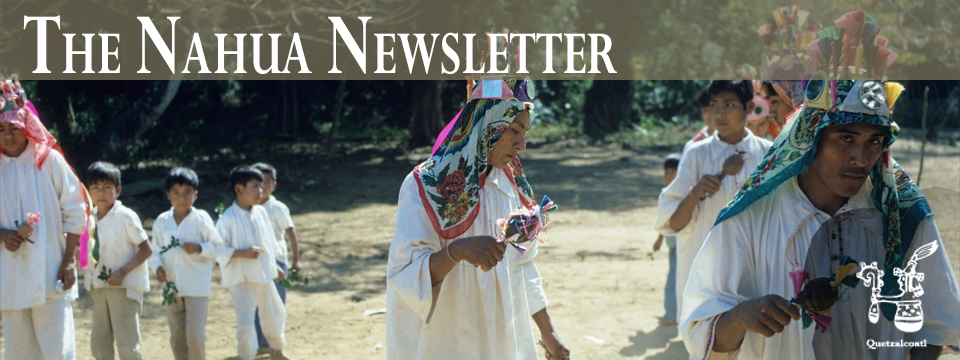
Editor’s note: This content is archival.
Nahua Newsletter
February 1997, Number 23
 The Nahua Newsletter
With support from the Department of Anthropology
Indiana University-Purdue University Fort Wayne
A Publication of the Indiana University
Center for Latin American and Caribbean Studies
Contents
- Newsletter News
- News Items
- Book Reviews
- Healing with Plants in the American and Mexican West. By
Margarita Artschwanger Kay. Tucson: University of Arizona Press, 1996. Pp. xvii+315.
$50.00 (cloth), $l9.95 (paper). ISBN 0 8165-1646-4. Reviewed by George M.
Foster. - A War of Witches: A Journey into the Underworld of the
Contemporary Aztecs. By Timothy J. Knab. New York: HarperCollins, 1995. Pp. 224. ISBN
0-06-251264-1. Reviewed by Doren L. Slade. - Stabilizing Indigenous Languages. Edited by Gina Cantoni.
Center for Excellence in Education Monograph, Special Issue. Flagstaff: Northern
Arizona University, 1996. Pp. xvi+240. Reviewed by David L. Shaul. - Holy Wednesday: A Nahuatl Drama from Early Colonial
Mexico. By Louise M. Burkhart. Philadelphia: University of Pennsylvania Press, 1996.
Pp.xii+314. $42.95 (cloth), $18.95 (paper). ISBN 0-8122-3342-5 (cloth), ISBN
O-9122-1576-1 (paper). Reviewed by Gordon Brotherston. - Commentary
- The 16th-Century Conversion of Mesoamerican Indians to
Catholicism: A Case of Cultural Fatigue” by Hugo G. Nutini. - Illustrations This Issue
- Directory Update
Newsletter News
Welcome to the February 1997 issue of the Nahua Newsletter. In these pages you will
find announcements, book reviews, and an essay by Hugo Nutini that will be of interest
to students and scholars with a focus on the Mesoamerican culture area. The NN
continues to attract new subscribers and positive responses from its loyal readers. The
sole purpose of the newsletter is to facilitate communication among people interested
in the history, language, and culture of Nahuatl-speaking peoples and other groups in
Mesoamerica. In the last issue, we published a complete directory of subscribers, which
resulted in a number of people sending in address updates or corrections. These changes
are listed at the end of the newsletter under Directory Updates.
Long-time readers know that the NN comes out twice a year, in November and February.
We publish announcements of coming events, calls for information or cooperation,
accounts of current research findings, and brief summaries of research projects. Please
take a moment and write to the address listed below and inform your colleagues of your
activities. The NN is an excellent way to get your name out to the people who count. We
have a targeted audience of over 370 subscribers who live in 15 countries. If your
statement is longer that a few words, please send it on a 3.5-inch diskette using
WordPerfect software or saved as an ASCII text file. This both saves the labor of
retyping and insures the accuracy of your communication.
In appreciation of their service to Nahua scholarship, we acknowledge the following
individuals who have published reviews in the NN, from issue Number 21, February 1996,
to the present issue. Thank you all.
- Norman W. Bradley
- Richard Bradley
- Gordon Brotherston
- Louise M. Burkhart
- George M. Foster
- Yolotl González Torres
- Michel Graulich
- Byron E. Hamann
- Cindy Vandenbergh Hull
- John M. Ingham Barry L. Isaac
- Cecelia F. Klein
- Luis Leal
- Eileen M. Mulhare
- Frances A. Rothstein
- Doren L. Slade
- Russell Salmon
- Alan R. Sandstrom
- David Shaul
- Gregory F. Truex
Thanks to the generous donations of our readers we have sufficient funds in the NN
account to cover this and part of next November’s issue. The NN is sent free of charge
to interested parties and we must rely on donations to cover the expenses of printing
and mailing. About one third of our subscribers live outside of the U.S., and it is the
cost of mailing the NN abroad that takes up most of the annual budget. We want to keep
the NN truly international and so reaching these subscribers is crucially important to
our mission. If you can afford it, please send a check to help preserve the sense of
community felt among scholars and students interested in Mesoamerica. Send checks made
out to “Nahua Newsletter” to the address below. All funds are used to offset the
expense of printing and mailing the newsletter – there are no administrative costs.
Please forward all communications or donations to:
Alan R. Sandstrom, NN EditorDepartment of Anthropology
Indiana University-Purdue University Fort Wayne
2101 Coliseum Blvd. East
Fort Wayne, IN 46805
News Items
(1) GRANT AWARDED: Alan Sandstrom would like to announce that he will be on
sabbatical next year and has received an American Council of Learned Societies (ACLS)
Research Fellowship for 1997-1998. He will return with his wife, Pamela Effrein
Sandstrom, and their 14-year-old son, Michael, to Mexico to continue long-term
ethnographic field work in a Nahua community in the municipio of Ixhuatlán de
Madero, northern Veracruz. The title of the project is “Milpa Horticulture and the
Transformation of the Mexican Economy.” The research will focus on the changing place
of the milpa in Nahua culture in response to the recent amendment of Mexican agrarian
law. The next issue of the Nahua Newsletter will be sent to you from the field. Please
continue to mail all correspondence to the editor’s university address, and mail will
be forwarded to Mexico.
(2) CALL FOR PAPERS: 14th International symposium on Latin American Indian
Literatures, July 14-18, 1997, Universidad Peruana de Ciencias Aplicadas, Lima,
Peru.
Topics may be drawn from the fields of anthropology, archaeology, art, astronomy,
architecture, bibliography, codices, history, indigenista literature, linguistics,
literary studies, medicine, religion, rock art, etc., and must be clearly related to
indigenous literatures. Delivery time will be 30 minutes plus 10 minutes for
discussion.
To be considered for participation, please send a 150-200 word abstract in Spanish
or English. To make your paper more accessible to students and colleagues in Peru,
please deliver your presentation in Spanish, if possible. Send abstracts to: Monica
Barnes, Program Chair, 377 Rector Place 11J, New York, New York 10280, U.S.A. E-mail to
103225.12@compuserve.com. The deadline for the receipt of abstracts was February 28,
1997 [write for further information about late receipts]. Each abstract will be
evaluated as it as received and notification will be sent as soon as possible.
Include your name, complete address, phone number, fax, and e-mail address. Dues for
1997 of US $25.00 ($5.00 for students or retirees) must accompany the abstract, plus
the symposium fee of US $100.00 ($40.00 for students or retirees). If this presents
difficulties, contact the Program Chair. Make a single check payable to
LAILA/ALILA.
Papers will be evaluated by three referees and if quality warrants, chosen for
inclusion in our series of published symposia papers. Instructions for submission will
be distributed at the meeting.
The conference will include a half-day excursion to the site of Pachacamac, south of
Lima. Two optional excursions are planned, one to Chiclayo on Peru’s North Coast (Sipan
and Tucume archaeological sites, site museums, Rock art site, Brunning Museum, towns of
Chiclayo and Lambeyeque, Brujería market, traditional music and food (July
19-21) and to Chachapoyas where the U.P.C.A. is conducting research (July 23-25).
Prices and detailed itineraries will be sent with acceptance letters. Information about
lodging, meals, and transportation will be sent with acceptance notices.
(3) CALL FOR PAPERS – NOTICE OF MEETING DATES. The NN received the following notice
from Frederic W. Gleach, Secretary-Treasurer of the American Society for
Ethnohistory:
The American Society for Ethnohistory will hold its 1997 Annual Meeting in the
National Museum of Anthropology in Mexico City, November 13-16, 1997. Papers, organized
sessions, special events, or speakers treating any world area are encouraged. Abstracts
of 50-100 words on appropriate submission forms and pre-registration fees of US $40
(for regular participants), US $20 (for student or retired participants), or N $40 (for
Mexican participants) are due by June 6, 1997. Write for submission forms and return to
either of the organizers:
William O. Autry, 1997 ASE Program Co-Chair, P.O. Box 917, Goshen, IN
46527-0917
e-mail:billoa@goshen.edu / voice: 219-535-7402 / fax: 219-535-7660; or Jesús
Monjarás, Director de Ethnohistoria, INAH, Paseo de la Reforma y Calz. Gandhi,
Col. Polanco, CP 11560, México D.F., México.
Limited travel funds will be available on a competitive basis for students
presenting papers. More detailed abstracts will be required. Please write to William O.
Autry at the above address for application forms and further details.
(4) MEETING ANNOUNCEMENT: The 20th Annual Midwest Conference on Mesoamerican
Archaeology and Ethnohistory will be held Saturday, March 15, 1997, at the University
of Michigan, Ann Arbor, West Conference Room, 4th Floor, Rackham Building. This year’s
conference is sponsored by the International Institute, Rackham School of Graduate
Studies. This informal meeting is well worth attending if you would like to hear
high-quality papers on a wide variety of topics and rub shoulders with fellow
Midwestern Mesoamericanists. For more information, contact Laura Villamil by e-mail at
villamil@umich.edu.
(5) NEW PUBLICATION: The University of California Press announces publication of The
Public Historian special issue on “Representing Native American History,” Volume 18,
Number 4.
This special issue is edited by Clara Sue Kidwell, Director of the Native American
Studies Program at the University of Oklahoma, and Ann Marie Plaine, Assistant
Professor of History at the University of California at Santa Barbara. Gathering voices
from a range of academic disciplines and nonacademic professions, this impressive
218-page volume responds to one of the most important issues facing historians of the
United States: creating complex histories of intercultural contact.
Six essays consider how museums, monuments, and public parks must address their
historical role in glorifying Euro-American civilization, including the conquest of
indigenous peoples, and presenting artifacts of Native Americans as devoid of history.
Grassroots American Indian activists in the 1960s and 1970s worked to reclaim national
shrines and holidays. Their efforts have challenged public historians to re-present
American Indian histories for audiences unaware of new interpretations of past events.
Although the essays focus on American Indians, the authors raise issues that public
historians face every day – the reconciling of a plethora of diverse public mythologies
and ideologies in the presentation of history.
Published by the University of California Press for the National Council on Public
History, Representing Native American History follows in The Public Historian’s
eighteen-year tradition of bringing readers a range of perspectives on public history
sectors, including museums, archives, cultural resources management, corporate
biography, historic preservation, public policy, and federal, state, and local
history.
This issue of TPH includes over ten book reviews, review essays, and reviews of
museum exhibits. Review copies are available upon request. Address single issue orders
and subscription orders to: The Public Historian, University of California Press, 2120,
#5812, Berkeley Way, Berkeley, CA 94720-5812. You can reach us by e-mail:
journal@garnet.berkeley.edu, or for more information, visit our Website at
http://www.lib.berkeley.edu:8080/ucalpress/journals. Please address editorial
correspondence to Lindsey Reed, Managing Editor, Department of History, University of
California, Santa Barbara, CA 93106-9410 / e-mail:LREED@descartes.ucsb.edu. Visit the
National Council for Public History Website at
http://www.iupui.edu/it/ncph/ncph.html.
Book Reviews
Healing with Plants in the American
and Mexican West. By Margarita Artschwanger Kay. Tucson: University of Arizona Press,
1996. Pp. xvii+315. $50.00 (cloth), $l9.95 (paper). ISBN 0 8165-1646-4.
In writing Healing with Plants, Margarita Kay has a dual goal in mind, the first
applied, and the second scholarly. The applied goal is in the early medical
anthropology tradition, exemplified by Benjamin Paul”s 1955 Health, Culture and
Community and Lyle Saunders 1954 Cultural Difference and Medical Care. That goal is to
make available cultural information that enables health-care personnel working in
cross-cultural settings better to understand the medical beliefs and behavior of their
clients. Thus she writes, “Health-care providers need to appreciate how culture affects
what their patients do about health-care problems. They should become acquainted with
the alternative therapies that are sought…. and should have facts that can help them
decide whether to incorporate such therapies or advise against them…. This book is
addressed particularly to those who see themselves as medical cultural brokers,
facilitating and clarifying communication between…. physicians, pharmacists,
therapists, and especially nurses – and their patients” (p. 5). However, the author
cautions readers that Healing with Plants should not be used as a guide to treatment:
“first, the information is insufficient to allow the health-care provider to prescribe
any of the plant medicines as treatment, and second, in no way is the material suitable
for the lay person to initiate self-treatment” (p. 11).
Kay’s scholarly goal is to identify the 100 genera of plant remedies she feels are –
or were in the past – most commonly used in the American and Mexican West, and to
provide basic information such as scientific names, species used, their place of
origin, present and past medical uses, the known activity of plant constituents, and
their toxicity. This section (Part 2 of the book) takes up nearly two-thirds of the
text (pp. 79-272). For most anthropologists these pages will be of particular interest
since they deal with long-standing concerns such as the place of origin (Spanish or
indigenous New World?) of many traits in Mexico, as well as the acculturative processes
whereby classical humoral beliefs and practices and native New World counterparts were
melded into a single medical system.
Part l of Healing with Plants is comprised of four relatively brief chapters that
provide the context for the plant data proper. Chapter l, “Ethnohistory,” identifies
the region Kay calls the “American and Mexican West,” roughly, the area south of the
Gila River, west of the Rio Grande, north of the Rio Sinaloa, and east of the Pacific
Ocean. The peoples concerned include, in addition to Mexican-Americans in the United
States, and Spanish-speaking Mexicans in Mexico, native peoples whose languages are
Piman, Tepehuan, Yaqui, Mayo, Tarahumara, Warijio, Ópata, Seri and Paipai.
In Chapter 2, “Plants, Their Names, and Their Actions,” the author lists the 100
plant genera in tabular form, their presence among the above-mentioned groups, as well
as pre Columbian occurrence in the Old or New World, and whether or not they were noted
by 18th century writers. She discusses the difficulties in providing botanical names of
Aztec plants, a task complicated by the fact that many genera are, and were, found both
in the New and Old Worlds, with recorded medical uses.
In Chapter 3, “Illnesses Treated with Plants,” Kay summarizes the ways in which
plants are prepared and used as medicine, and the kinds of ailments for which they are
used. Chapter 4, “Healing the Illnesses of Women and Children,” covers much the same
material, as applied to childbirth, fertility, abortion, menstrual problems, and the
like.
Finally, to be noted is a short “Bibliographic Essay,” which in conjunction with an
admirably comprehensive bibliography, makes it possible to avoid endless footnoting in
the text proper. This, in fact, is one of the joys of reading Healing with Plants. The
author does not feel it necessary to cite every source on every occasion that data are
drawn from it. The result is an uncluttered text that permits the reader to keep his or
her mind on the main points being made. Would that more anthropologists would follow
Margarita Kay’s lead!
Most anthropologists will want to read all of Part l as well as the bibliographical
essay. Part 2 is fascinating but not light reading; it lends itself to browsing rather
than intensive scrutiny. But for the serious student of ethnohistory, it is a mine of
information unparalleled in other readily available sources. Is a particular herb Old
World or New World in origin? Or does the genus have both Old and New World
representatives used medicinally? What humoral qualities were assigned to these
remedies? Here one finds the answers.
I find much to praise in Healing with Plants and little to criticize. I do feel,
however, that Kay might have gone a bit farther in explaining the logic underlying
humoral theory. Whatever the origin of the “hot-cold” concept in the New World, it is
the basic unifying theme inherent in popular Mexican ethnomedical theory, including
Kay’s data. As such, it deserves more than the short explanatory paragraph found on
page 20. A page or two of description, including both historical data and contemporary
ethnographic accounts, would go a long way in making clear the logic lying behind many
beliefs and customs Kay mentions. For example (p. 67), we read that during their first
menstruation girls must steer clear of “wrong diet” (i.e., “cold” foods) to avoid
subsequent menstrual difficulties. Further, fear of “the potentially chilling effects
of immersion in water [bathing, swimming, and washing of hair] were considered
dangerous” to menstruating women. But the reader is given no hints as to why “cold”
foods constitute wrong diet, nor why chilling effects of water are considered
dangerous.
Yet when we realize that in all humoral systems blood is thought to be thermally
and/or humorally hot, the logic becomes apparent. A normal quantity of blood in the
body keeps one’s temperature at the correct level. Loss of blood, through childbirth
and menstruation, lowers a women’s temperature to a point where she is particularly “at
risk” from additional chilling insults in the form of “cold” foods as well as water,
normally considered to be a cooling substance. By the same token, the popular
perception that blood normally lost during menstruation is retained in the body during
pregnancy, thus raising a woman’s temperature to an “at-risk” point, explains many
Mexican and Mexican American pregnancy beliefs.
Against the strong points in the book this is a minor criticism. Overall, Healing
with Plants is extremely well researched, and full of fascination to the “medical
cultural brokers” Kay sees as her major audience. And every anthropologist concerned
with Mexican and Mexican American ethnomedicine will find much in this work that is of
relevance to his or her studies.
A War of Witches: A Journey into the Underworld of the Contemporary Aztecs. By Timothy J. Knab. New York: HarperCollins, 1995. Pp. 224. ISBN 0-06-251264-1.
All ethnographies are stories we tell about the people we engage in the field. As
such, they are also stories about our experience. Timothy Knab has offered us a complex
and rewarding book, compellingly written in narrative form about his fieldwork, what
these experiences meant to him, and how he came to understand Sierra Nahuat cosmology.
With A War of Witches, Knab makes his first contribution to narrative anthropology (p.
224). Yet, this book is rather like the perennial elephant encountered by blind men on
the road: some readers feel the trunk and some feel the tail but each believes that she
or he has comprehended the entire beast. For this reader, an anthropologist and
practicing psychoanalyst who has spent over twenty years doing research in the same
region, the tale recounted by Knab is carefully crafted around a particular set of
evocative experiences. These experiences center upon Knab’s relationship with three
main characters from a small community near Cuetzalan in the Sierra Norte de Puebla,
disguised by the name “San Martín.”
The two main protagonists are locally famous curanderos, healers who are also
witches. The third is the tonal (soul) of a victim of witchcraft whose interactions
with Knab occur in Knab’s dreams. The curanderos, whom he calls Doña Rubia and
Don Inocente, served as Knab’s primary informants as they had for anthropologists
preceding him. Knab’s command of Nahuat facilitated his shrewd and willing instructors’
task of teaching him to become a curandero and follow the “path of the ancestors.”
Doña Rubia and Don Inocente represented to Knab repositories of mysterious
knowledge that seemed at times out of the reach of understanding even for the
anthropologist-apprentice. At once an anthropological tale, a murder mystery, and a
personal narrative, Knab has succeeded in writing an ethnographic novel that should be
read by Nahuat specialists and will certainly entice anyone interested in witchcraft,
fieldwork memoirs, or those curious about ancient and present-day Aztec peoples,
especially those believing in the persistence of pre-Hispanic cosmology in the lives of
Nahuat-speakers today. But this book is far more complex than that.
Seemingly an easy read, one must sift carefully through involuted layers of
experience and hinted-at meanings as the reader is guided through images so vivid that
one familiar with the Sierra Norte and its people is transported through the mist, back
into the very mountains in which Knab’s narrative unfolds. Although the story told is
located in time during the 1970s and, as Knab informs us, involves fictionalized events
aimed at enhancing the power of the narrative, the richness of ethnographic detail
rests squarely upon Knab’s twenty years of fieldwork in the Sierra. This account
(written we only learn at the end of the book with Peter Shotwell, a professional
writer and editor) narrates Knab’s journey of discovery through which the reader can
glimpse Knab’s struggle with his own ethnocentrism. Knab chronicles his encounter with
the “Ethnographic Other” by combining dialogue, narrating private musings and outright
frightening experiences, and by recounting captivating dream sequences in which that
encounter is epitomized. In Knab’s choice of the narrative voice, his own vision of his
existence falls neatly into perspective with his recounting of his story so that the
reader, in turn, becomes immersed in the lived experience of the story being told.
Knab acts as our guide on dream journeys to Talocan, the underworld of the ancient
Aztecs and a place very much alive for the people of San Martín. Through these
dreams, Knab is challenged to question his assumptions about the nature of things. In
dreaming of Talocan, the truths of Knab, Doña Rubia, and Don Inocente converge
until Knab is inescapably confronted, in spite of himself, with questioning the
absolute conviction of his own beliefs and the “validity” of the beliefs of others.
Thus, implicit in the narrative is the juxtaposition of what one could call an
empiricist reality (Thomas Jefferson’s “true facts”), and subjective truth, that is,
what is true in the reality (read experience) of the believer. In this way Knab’s book
is a portrait of the struggle facing all fieldworkers to reach beyond themselves and
grasp the lives of those encountered.
Told in the first person and without introduction of any sort, we are immediately
transported to the Sierra and find ourselves with Knab under the eaves of Don
Inocente’s house in the middle of a plot to murder a woman’s son-in-law with candles
dipped in herbs that will paralyze the young man’s lungs. Don Inocente’s agreement to
perform this service reveals to Knab his identity as a witch, a secret kept from Knab
during some seven years while Knab studied storytelling in San Martín. Almost
immediately, Sanmartino cosmology comes alive to the reader.
A premise of justice is central in the organization of the Sanmartino world view and
justifies to Sanmartinos, the place and efficacy of witchcraft in their lives. Justice
is maintained through a form of reciprocal vengeance that ties the Lords of Talocan and
those living on the Earth to each other: “When nobody likes someone, and there is much
envy, the Lords can be tricked. They might help a man who seeks something that is not
just…. He asks the Lords to take his victim’s tonal. So if we help the Lords with
something ‘a bit evil,’ something savage, the Lords do not object. If something a bit
evil should befall someone who is unjust, or who is not living well, it just brings
them more food there in the earth . . . . But if the witch has fooled the Lords, the
one who was witched will later seek his own justice” (p. 155).
Doña Rubia has chosen to teach Knab to be a curer for reasons we discover as
the plot unfolds. In his apprenticeship, Knab learns that his dreams can have
significance. Dreaming is used in curing to enter and navigate the underworld in search
of souls. He discovers that every witch is a curer but not every curer is a witch. He
learns there are witches that are evil and seek personal gain, and witches who serve
the collective good by following “the path” (respecting the cultural ideal) by aiding
the Lords of Talocan in maintaining justice even through murder. Vengeance and justice
are clearly inseparable ideological elements in the beliefs of Sanmartinos and recall
the key cosmological premises of respect, reciprocity, balance, and harmony that
intertwine to organize the beliefs and ritual practices I describe for Chignautla, a
community not far away (Slade 1992).
When Doña Rubia suddenly falls gravely ill, Knab is summoned to the Sierra
from Mexico City where he is teaching. Although Knab immediately searches for the
“real” cause of her physical condition, which he suspects is bat disease, Rubia
implores Knab to help search for the cause of her illness in the underworld. And
because Rubia needs Knab to travel to Talocan she confronts him with his resistance to
becoming a true believer, that is, with his interest in their beliefs rather than the
fact of his believing: “You know only my words! You say them just the way I say the
prayers, but you do not really pray; there is no reason that you pray” (p. 27). Sadly,
he shies away from the difficulty of being even-handed in juggling multiple realities
or truths, if you will. In curing a young girl who is believed to be suffering from
soul loss, Knab initially attempts to and succeeds in identifying a physical
explanation for her symptoms. In the narrative it is clear that soul loss is relegated
to a secondary position in his mind. The curing rituals that Knab performs benefit only
the Sanmartinos since their beliefs do not reflect reality for him. It appears that
whenever an element of the story cannot be grounded empirically, the author begs the
question of the story’s believability. Knab offers us his position and then gives us
his doubts: “These cloudy connections between the ‘real’ and the ‘unreal’ confused and
amazed me. For the second time in the Sierra, but for different reasons, I was finding
it hard to use ‘metaphor’ in my usual anthropological way” (p. 31).
Thus, a reluctant Knab is emotionally blackmailed into making sacrifices in a cave
and running for his life from witches who chase him, even though for Knab, they exist
only in his mind, while he tries to serve both Rubia, himself and the Lords of the
underworld: “I wondered about the dark places in peoples’ psyches where witches worked”
(p. 107). Knab’s immersion in healing practices and his desperate quest to save Rubia
enhances his appreciation of the power of the specialized knowledge that witches
control. He ponders how he has arrived at dreaming in the culturally stipulated manner
for a curandero since he does not “believe in” such things: “It is strange to be told
you would see certain things in a dream state and then see them. I had always thought
of dreaming as a will-less state if I had thought about it at all” (p. 85).
Knab’s investigations ultimately lead him to discover a more complete picture of
witchcraft practices in spite of the reluctance of Sanmartinos to speak of such
matters. Knab is horrified to discover that witches comprise a large segment of the
population. He stumbles upon tales of multiple murders involving witchcraft, a war
between factions of witches that spanned the 1920s into the 1930s and culminated with
the crucifixion of a witch in front of the village church. Knab is driven to uncover
the historical facts of these strange events. All the while, he is propelled by his
struggle to provide a believable explanation for his experiences which he himself
barely comprehends since he remains a nonbeliever in the very events that enticed and
engulfed him. We learn that warring witches were an integral part of Sanmartino social
life. In effect, witches always served to balance the tensions occurring between the
haves and have-nots in Sanmartino society.
Knab neither directly interprets nor analyzes these happenings for the reader. His
narrative does not wander far from the safety of the classic views of Evans-Pritchard
(1937), and Kluckhohn (1944). After all that is said and done, witchcraft for Knab
invariably boils down to something empirically knowable, which includes psychological
states and sociological consequences. Knab skillfully portrays the disruptive force of
witchcraft that allows individuals to manipulate each other to gain power. Armed with
this academic truth about the nature of these practices and his knowledge of botany,
Knab questions whether or not supernatural acts can indeed produce natural outcomes but
never shares his thoughts on the matter with the reader. Instead, in his attempt to
persuade, he falls back on literary devices such as “quizzical interrogatives,”
repeated declarations of intellectual innocence and deliberately naive questions that
lend greater believability to his tale. We are left with a sense that these complex
phenomena will be abandoned to Knab’s greater existential quandary as to the nature of
truth and believability. Apparently, Knab’s dilemma does not escape his informants
either, as we can see from the statement of Don Inocente on the last page of the book:
“A witch is only a witch for one who does not understand the way of the Most Holy
Earth” (p. 204). How Knab places believers and nonbelievers in opposition to each other
within the narrative is most provocative.
In the last chapter, Knab supplies a history of San Martín set against a
backdrop of Mexican history that provides a context for the narrative and adds
credibility to his tale. Knab unravels the political and social forces that shaped life
in the community. With the arrival of a powerful cacique complete with small army, San
Martín was swept into the revolution and suffered the fate of many indigenous
communities of the Sierra. The cacique established himself at a large coffee plantation
near Cuetzalan and began a process of intimidation that would lead the villagers into
poverty and a war of witches after an initial period of affluence. Sanmartinos fell
prey to a typical form of profiteering. Purchase of goods from a “company store”
resulted in debts that were to be repaid by indentured labor or transfer of land titles
to the cacique. In this manner, corn production was replaced by the cash cropping of
coffee, which necessitated the purchase of corn. Knab captures the corruption of
local-level politics and the way individual Sanmartinos formed alliances and struggled
to improve their lot. The events portrayed and characters drawn are recognizable. Knab
portrays justice, communal harmony, and witchcraft as inextricably tied together in
practice as they are in Sanmartino cosmology. Thus, the tale within a tale within a
tale that weaves throughout the narrative provides either enjoyment or frustration for
the reader as layers of meaning are obscured or unfold for those who allow themselves
to be transported by the story.
If one asks of A War of Witches “Is it true?”, then it is likely that Knab’s
contribution will be lost in a sea of rhetoric concerning the nature of scientific
truth and the validity of subjectivity in generating knowledge. Part of the power of
Knab’s book rests on what it does not say, in the questions it generates in the reader
but refuses to consider. Knab teases us by raising a cluster of issues he does not
address. Has he or hasn’t he gone native? Does he really believe that he has become a
curandero whose powers exist beyond the context of the Sierra Nahuat of San
Martín? Was Knab on a personal quest or was he “doing anthropology” and how was
such a text created? What did his relationships to Sanmartinos mean to him and
particularly his relationship with Doña Rubia? What premises remain latent in
his vision of the world that intruded upon how he experienced the Ethnographic Other,
and does this become more problematic because the author is both spectator and actor in
a personal narrative? I suspect that Knab’s choice not to make explicit his operating
assumptions will create doubt in some readers and, as a consequence, the credibility
(i.e., authority) of the narrative will be taken less seriously than it should. Knab
offers few opinions and readers may be encouraged to conclude that his ethnocentrism is
more unconscious than it perhaps may be. In effect, we are left to wonder what exactly
does Knab believe he is believing, which crystallizes his dilemma with authorship and
authority, that is, his concern with the narrative presented and the credibility of the
data used to construct the narrative.
It is not the ontological nature of belief that Knab grapples with but rather the
experience of believing. Reading A War of Witches brings to mind continuing dialogues
that fill anthropological journals these days – far too many to mention here. Knab’s
issue with believing carries us into debates over the nature of cultural constructions,
the construction of “truth” and “reality” and the intersubjective contexts in which
these constructs matter most and, simply put, the role of beliefs in experience. We
become trapped in Knab’s dilemma of causality. Taking the liberty of putting words in
his mouth, I believe it would go something like this: “I never thought Sanmartinos were
really doing things to each other, only that they thought they were doing things to
each other, only to discover that they were really doing things to each other and could
even do them to me, or have me do them to others.” I agree with Ewing when she writes:
“To rule out the possibility of belief in another’s reality is to encapsulate that
reality and, thus, to impose implicitly the hegemony of one’s own view of the world”
(1994:572). In anthropology, the struggle to articulate the nature of the field
encounter continues. What I have learned from reading A War of Witches is that in order
to not use our beliefs to keep our distance, and thereby truncate our understanding, we
must grant that cultural relativism is a justification for not taking seriously the
beliefs of those we intend to understand. Knab never fully transcends his preoccupation
with “how you know what you know” in other than empirical terms, and he relies heavily
upon the credibility naturally granted any eyewitness account in our society.
“Being there,” as Geertz (1988) puts it, creates a certain authority in the text
that is directly dependent upon the believability of the author’s personal experience.
As the eyewitness, Knab seems compelled to depict the events of the narrative as either
objective facts or cultural constructions thereby placing himself equivocally in
between. This may be a ploy to enhance tension in the story or to intensify the alien
nature of the events portrayed, but in the end, Knab has written a book dedicated to
the meaning of his experiences in the field and we close the book without truly
grasping what these experiences actually meant to him. Thus, A War of Witches at times
seems too precious a document. It is an unself-conscious text in which the reader
remains uncertain as to whose truths are revealed, whose truths are challenged, and
whose truths are believable.
References Cited
Evans-Pritchard, E. E. 1937. Witchcraft, Oracles, and Magic among the Azande.
Oxford: Clarendon Press. Ewing, Katherine P. 1994. “Dreams from a Saint:
Anthropological Atheism and the Temptation to Believe.” American Anthropologist
96:571-83. Geertz, Clifford. 1988. Works and Lives: The Anthropologist as Author.
Stanford: Stanford University Press. Kluckholn, Clyde. 1944. Navaho Witchcraft.
Cambridge: Peabody Museum Papers, No.22. Slade, Doren L. 1992. Making the World Safe
for Existence: Celebration of the Saints Among the Sierra Nahuat of Chignautla, Mexico.
Ann Arbor: University of Michigan Press.
Stabilizing Indigenous Languages. Edited by Gina Cantoni. Center for Excellence in Education Monograph, Special Issue. Flagstaff: Northern Arizona University, 1996. Pp. xvi+240.
This book is aimed at a sympathetic audience, and repeats truisms that are worth
repeating here: (1) there needs to be local community involvement and control in
language renewal/retention policies and planning; (2) parenting is ideally done in the
native language; (3) there is always a need for basic research (grammar, dictionaries)
and relevant teaching materials; and (4) every program depends on local conditions –
there is no cure-all method or tactic that will work everywhere.
The book in the initial chapters provides bibliographic coverage (from 1980 to 1996)
and policy background (the Native American Language Acts of 1990 and 1992 and related
documents). These early chapters provide a focus for the book.
Governmental Indian policies of forced assimilation did not work because of social
and economic isolation and cultivated resistance; language shift depends on factors
internal to the community. After World War II, connection to a money economy, plus the
education and material goods connected with it, caused the initial erosion of Native
American languages, with television and sister media nearly completing the process
since the 1970s.
Minority language retention depends on a positive attitude toward the native
language, and the creation of a language loyalty that fosters the local language while
accepting the language of the dominant culture in appropriate contexts, thus making a
balanced linguistic economy (ecology would be a better term) that linguists call
“diglossia.” The main focus of linguistic economy that the book presents is
education.
Fishman’s chapter on methods of stabilizing a minority language (pp. 80-91) and
James Crawford’s chapter on language loss (pp. 51-68) are the core of the book. Revival
methods include: using practical, every-day areas of vocabulary (with necessary
grammar) to start off with; and teaching materials grounded in the daily reality of the
learner/users. Where there are fluent and older speakers, suggestions include early
literacy, starting schools where the local language is fostered and where contact with
older persons in the community can be maintained.
Early education is the basic recommendation of the book, and this is echoed
elsewhere in reports of successful programs: the Two-Way program for teaching Navajo
(p. 125) that mixes fluent children with passive and non-fluent children, and
family-run preschools in Hawaiian (p. 153). Both of these strategies, of course, take
advantage of the fact that preadolescents learn languages with relative ease – with the
added bonus of avoiding labeling children.
While the need for local community control over education and language policy is
obvious, the books fails to address two other factors that follow from a local language
renewal program/policy. First, the need for local language professionals who can teach,
translate, and create/edit materials in a variety of media. And second, consistent
funding for these efforts. The ideal program seems clear: day care conducted in the
language with regular visits by elders; graded videotapes, audio tapes, story books,
and computer games; follow-up of language arts in the local language in charter schools
or home schooling – if these are the only feasible choice.
Local communities will probably need help in basic research (because most existing
grammars and dictionaries are esoteric to non-linguists), and in training of local
language professionals to get started in teaching, curriculum development, mentoring,
and media skills. Academic units and tribal consortiums can help, but consistent local
funding is needed over a decade to produce a new generation of fluent bilinguals.
This sort of radical program is hinted at in the book but not boldly articulated in
one single policy statement. Indian tribes have the legal right to determine their own
education instead of depending on states for teacher certification and policy control.
Funding at the local level is the key to linguistic renewal and stabilization. The
methodology and resources, and presumably the motivation, are all there. It is the
issue of how to attract and maintain funding that must be addressed in the next
book.
This book is a good state-of-the-art handbook, for the reasons given. Of special
interest to the readers of this journal are the chapters on Nahuatl in central Mexico
(pp. 163-73) and Tarahumara, a Uto-Aztecan language spoken in the north of Mexico (pp.
174-81).
Holy Wednesday: A Nahuatl Drama from Early Colonial Mexico. By Louise M. Burkhart. Philadelphia: University of Pennsylvania Press, 1996. Pp.xii+314. $42.95 (cloth), $18.95 (paper). ISBN 0-8122-3342-5 (cloth), ISBN O-9122-1576-1 (paper).
According to the editor Louise Burkhart, this Nahuatl version of Miércoles
santo is the earliest extant script of a play in an American language. Based on a
Spanish original written in the 1580s by a Valencian playwright named Izquierdo, the
18-page manuscript was recently acquired by Princeton University Library and here
receives a very thorough introduction and commentary. It belongs to the devotional
literature characteristic of Holy Week and deals specifically with Christ’s Passion and
his harrowing of Hell. In editing this work, Burkhart finds an opportunity to amplify
and detail the theses she set out in her excellent The Slippery Earth: Nahua-Christian
Moral Dialogue in Sixteenth-Century Mexico (1989).
The Nahuatl play, by unknown hands, most likely dates to within ten years of the
original. It lacks a title and has as its first line: “In titlacen panohuica
çihuapilli . . . . ” In general, it follows the Spanish text quite closely,
finding equivalents for doctrinal terms or occasionally leaving them untranslated. At
certain points, however, it makes some changes, which though small, strongly affect the
overall argument and meaning of the piece, and secure the notion that the translator or
translators were Nahua rather than Spanish.
Contemplating these changes, Burkhart enters into a brief yet extremely lucid
discussion of translation itself, as it is defined respectively in the Spanish and the
Nahuatl languages. Rather than a carrying across of meaning, she says, the Nahuatl word
cuepa suggests a turning around and giving back, a response or change. The Nahua
therefore “avoid the fallacious assumption that translation can be a mere conveyance.
And they leave space within the practice of translation for the translator to respond
to the text, to change it, to turn it to his or her own ends, to return it to earlier
discourses that inform its interpretation” (p. 101). This kind of shift is certainly
evident in such other major cases of 16th-century translation into Nahuatl as
Sahagún’s Psalmodia and the Tlauculcuicatl lament (previously analyzed by
Burkhart), or the version of Aesop’s Fables produced by an anonymous but certainly
native rather than Spanish scholar.
In the play Miércoles santo, Christ the Savior is left with an option in the
Spanish original and may decide whether or not he will choose actually to suffer and
die, to effect the redemption he in principle is capable of anyway. The Nahua text
leaves him no choice ‹ only by self annihilation can he hope to achieve his
purpose. That is, he must emulate the pagan gods of Mexico who hurled themselves to
destruction in order to set the sun and time in motion. Then, in the Spanish, those he
goes to save when harrowing hell are closely defined as Old Testament patriarchs who
foretold his victory. In the Nahuatl, the category is broadened so as not to exclude
ancestors of Mexican rather than purely Old World origin: “my precious ones and a great
many others” (the Spanish refers only to “these my beloved children”). Hence, as
generic pre-Christian ancestors liberated from the underworld, these “others,” in
Burkhart’s words, “may attain pardon for their errors and merit escape from their
torments” (p. 95). This translation is significant evidence of a strategy to adapt
Christian cosmogony and history to American needs.
As Burkhart makes clear, these modifications are the more striking in view of the
fact that we are dealing with a performed text, words and dialogues played out directly
before the citizens of the New World. Drawing deeply on custom and inherited resources
of rhetoric and oratory, the Nahua Christ and his mother address each other more
delicately, with greater apparent respect and tenderness, and as a result come to seem
more akin to the native audience that surrounds them physically: “When Christ and Mary
were played by Nahua actors, spoke proper Nahuatl, and behaved toward one another
according to Nahua codes of politesse, their non Spanishness in itself added a subtext
to their script” (p. 98). At the same time, in the wake of the bloody military invasion
led by Cortes, Christ’s Roman oppressors could not but evoke the Spaniards
themselves.
The same kind of logic may be seen at work in other dramas of the period that share
a missionary intent with In titlacen, as José Juan Arrom shows us in his
fundamental Teatro hispanoamericano: época colonial (a work that Burkhart
curiously omits to mention). The lesson of Adam and Eve’s Fall was, for example,
similarly modified, in a Nahuatl version lavishly staged in Tlaxcala in 1538. Every
skill went into highlighting Eden as the place that American agriculture had actually
made possible, into a testimony in maize and other plants to native achievement in this
world age, so that the mere verbal message about human misery and helplessness could
only acquire a certain irony. Again, in the Eecaliztli or Challenge issued to the
recently converted Tepoztecatl by his still-pagan neighbors, this figure is taunted for
having betrayed the old gods and gone over to the Christians. He counters them by
invoking, not God, but the “eleven cliffs and ravines,” each with its pagan name and
shrine, which have always shielded him and given him strength and the power to resist,
a message that is heard very clearly today in the annual performances in Nahuatl that
take place in Tepoztlan each September. Along with In titlacen, these are all examples
of the larger phenomenon of naturalization that imported texts and creeds have
undergone in America and that is no less evident in the Quechua tradition of the
Andes.
Highly productive, Burkhart’s approach to In titlacen can lead to further
recognition of major shifts in the Nahuatl, which perhaps for lack of space go
uncommented upon. A striking case comes in the confession that Adam issues from Hell,
concerning his sin of gluttony (rather than pride). In the Nahuatl, this leads to a
notable reference to Eden that is entirely absent in the original: “I ate the fruit,
the produce of the tree of life, which our lord God, the sovereign, prohibited to me,
there in terrestrial Paradise, so that I would not eat it.” Given the Tlaxcalan
precedent, there seems to be no reason not to see in this added detail an allusion to
the very different American tradition of genesis, where it is the effort of human
agriculturalists that brings about the terrestrial paradise of “fruit and produce.”
Unfortunately, it is hard for the reader to judge the matter better because of what
stands out as the major flaw of this otherwise welcome and expert edition. For we are
able to know the play only in English translation, and neither the Spanish nor the
Nahuatl text is given. True, in Burkhart’s detailed commentary, a whole series of cases
are discussed in which words and phrases from the Nahuatl are thoroughly analysed,
sometimes with apt further reference to the visual language of Mexican codices and
mural painting. Yet clearly this can never be enough in itself (there is nothing about
the “tree of life” or “terrestrial paradise,” for example), and the editorial decision
to omit the original text serves not at all the reader who is anxious to feel the
cadence and flow of the Nahuatl, or to judge its difference from the Spanish in
precisely the terms of oratory and argument that the editor herself recognizes to be of
key significance. This is a crippling limitation, for which no reasons are given.
The absence of the Nahuatl text in turn makes it harder for the reader to engage in
the larger and topical question of adaptation versus continuity raised by the play,
which deserves detailed comment. In showing how Miércoles santo becomes a Nahua
play, the editor uses the approach of linguisticians like William Hanks who, with
reference to post-Hispanic discourse, has shown the great degree to which the
terminology of Spanish government and law, through translation into Maya, was made to
serve local argument. In countering received notions of “purity” versus
“acculturation,” both lamentable terms, this approach is welcome and illuminating. Yet
there appears to be a danger of the concept of adaptation being over-applied at the
expense of (quite compatible) concepts of continuity. In Hanks’s case, there is all the
difference between the Chilam Balam books, strongly rooted in the hieroglyphic corpus
yet little discussed by him, and the kind of collaborator statements he has focused
most on. Similarly, Burkhart too readily equates her play as a Nahuatl text with
contemporary works in that language which in fact stem from very different sources and
have very different aims.
One of these works is the Cuautitlan Annals, written down in 1570 by (according to
Burkhart) a “Christian Nahua.” Referring to the story of One Reed Quetzalcoatl told in
this text, she notes how this character, having fled from highland Tula, is put in a
tepetlacalli (“stone coffer” in Burkhart’s translation), before he descends to the
underworld and rises again. She attributes this detail to the influence of the story of
Christ entombed. The implication is that Christ’s three-day journey to Hell had become
so significant for the Nahua as a paradigm that the need was felt to make One Reed’s
story somehow reflect and conform to it: “A similar desire for accommodation between
the old myths and the new affected the story of Quetzalcoatl’s descent to the
underworld and transformation into the morning star” (p. 95).
First, whether or not the Cuauhtitlan authors (for they were more than one) were
Christian hardly impinges on the overall argument they present, in seeking to root that
town’s political authority in the Chichimec expansion of the seventh century.
(Specified in other highland sources, this early foundation date is incidentally now
corroborated by the Nahuatl glosses on the Itzcuintepec Roll and related texts from
Cuextlan.) Second, the version of One Reed’s end referred to by Burkhart is not the
only one noted and evaluated by the Cuauhtitlan historians. And they present it as the
version which adheres most closely to the thoroughly Mesoamerican (and for that matter
North American) paradigm of the planetary passage through the underworld and ascent
into the eastern sky over nine nights or four plus four days. Through this paradigm,
the earthly ninth-century ruler One Reed is subsumed into the ritual Venus figure
Quetzalcoatl. As for the tepetlacalli, this is one of a number of toponymic references
in the Cuauhtitlan text which is firmly vouchsafed in the corpus of pre-Hispanic
place-glyphs.
So that even if (for the sake of argument) the tepetlacalli is deemed to be
deference to the Bible, that cannot affect the fact that One Reed’s story as a whole,
just like the Chilam Balam books of the Maya, overwhelmingly represents the principle
of continuity rather than adaptation of foreign elements. After all, the Cuauhtitlan
text is explicitly said to be not just a continuation but a transcription of earlier
texts in native writing that belonged to the same genre as itself, the xiuhtlapoualli
or annals genre. In any case, in no circumstances can we accept Burkhart’s accompanying
claim, regarding the days of the underworld journey: “the Christian sacred number three
is changed into the Nahua sacred number four” (pp. 95-96). Amongst a host of
pre-Hispanic sources, the Dresden Codex and the Twenty Sacred Hymns leave no doubt
whatsoever that the four-day paradigm proper to this epic passage through the
underworld was of considerable antiquity in Mesoamerica and could have had nothing to
do with the modifying of a supposedly Christian source.
To treat native histories like the Cuauhtitlan Annals and translations from foreign
originals like In titlacen as if there were the same sort of text is tantamount to
taking a good idea too far. Keeping the right balance between ideas of continuity and
adaptation is a prerequisite for a fair reading of the post-Hispanic corpus and becomes
quite critical in cases like that of the Cantares mexicanos, where, as John Bierhorst’s
edition makes plain, the Nahuatl authors weave between historical memory and current
predicament in the wiliest and wittiest fashion (notably in the “invasion” sequence,
Songs 69-72).
Finally, while in the case of In titlacen the notion of adaptation is of course the
more relevant since the work is a translation, even here it can help to bear continuity
in mind. The historical precedent implied by the existence of pagan Mexican forefathers
was still being expressed in the late-sixteenth century, in the writing down of native
annals that as a corpus formally cover thousands of years. And the fruit “produced” on
the tree of life in the terrestrial paradise evokes powerful differences between the
Biblical Genesis and the cosmogony of world ages and agriculture narrated in early
American literature.
Commentary
The editor invites short essays of a controversial nature to stimulate thought and
creativity and to begin a dialogue among interested scholars. Following is such an
essay on “cultural fatigue” among the peoples of Mesoamerica at the time of the arrival
of the Spaniards. It is contributed by the well-known Mesoamericanist Hugo Nutini and
we thank him for choosing the NN to publish his thoughts on this matter. We welcome
comments on the essay and will print whatever response is forthcoming so long as it is
germane to the topic and of general interest to the readership. Kindly send your
reactions to the address on the front page.
“The 16th-Century Conversion of Mesoamerican Indians to Catholicism: A Case of Cultural Fatigue”
Hugo G. Nutini Department of Anthropology University of PittsburghOne of the most imaginative anthropologists of the second half of the twentieth
century was John M. Roberts. His seminal ideas ranged from the nature of expression and
the organization of culture to the configuration of games and social stratification.
Virtually every conversation with him yielded some descriptive, methodological or
theoretical insight. This creative genius made Roberts the consummate collaborator.
From 1971 to 1989, when Roberts and I were colleagues in the Department of
Anthropology at the University of Pittsburgh, we worked together on several projects,
most notably witchcraft and sorcery in rural Tlaxcala, on social change in the
Tlaxcala-Pueblan Valley, and a study of the expressive and structural components of the
Mexican aristocracy. During the summers of 1979 and 1985, Roberts spent about six weeks
with me in several of my field sites (the Tlaxcala-Pueblan Valley, the Cordoba-Orizaba
region, and Mexico City). At the end of his visit in 1979, Roberts verbalized the
intriguing and profound idea that the Spanish conversions of Mesoamerican Indians to
Catholicism was probably a case of cultural fatigue.
Roberts habitually made provocative statements that challenged established theories
and conventional wisdom. Just as often, he exposed a new way of looking at a problem or
showed unsuspected connections in well-known bodies of information. Whatever the nature
and form of his ideas, Roberts made you think about their plausibility and the
possibility of testing them. This was an intellectual game that he played very
skillfully, and in many cases it led to collaborations that constituted some of
Roberts’ most significant contributions to the discipline. Unfortunately, he died
before he and I could map a strategy for testing the connection between conversion and
cultural fatigue. In sharing Roberts’ idea with fellow Mesoamericanists, I hope that
some enterprising young anthropologist would be aroused to undertake the task that
Roberts and I did not implement.
How Roberts came to see the Indians’ conversion to Catholicism in the 16th century
as a case of cultural fatigue is not entirely clear. As far as I am able to
reconstruct, his intuition (based on what he knew about Mesoamerica, but undoubtedly
colored by my knowledge of this culture area), drew on four main components: (1) the
bloody configuration of Mesoamerican polytheism; (2) the rapidity of the processes of
conversion and catechization, albeit somewhat superficial; (3) the passion and
intensity with which the Indians turned to the new religion; and (4) the thoroughness
of the process of syncretism that characterized the emerging Indian religion by the
beginning of the 17th century. Evidently, Roberts drew on Kroeber’s (1952:403-405)
account of cultural fatigue in Hawaii as a promising analytical model for re examining
the Indians’ conversion. The following consideration of Robert’s proposal will be
centered on the Nahua Orbit, the area that I know best.
Three of the main characteristic attributes of Mesoamerican polytheism included a
tremendous emphasis on human sacrifices to the gods, a pronounced concern with
bloodshed and the dead, and a significant degree of ritual cannibalism. These
characteristics had probably been present since the pre-Classic period but apparently
reached a peak of intensity in the late post Classic period (from perhaps 1200 A.D. to
the arrival of the Spaniards), and nowhere were they more evident than among the
Mexica-Tenochca of the Valley of Mexico. Although there were differences of intensity,
this generalization applies to all Central Mexican and probably most of the indigenous
societies from Oaxaca to the northernmost frontier of Mesoamerica.
The information available on human sacrifices is uneven and not always entirely
reliable, but no serious scholar (except Eulalia Guzmán) has ever denied that
the ancient Mesoamericans practiced human sacrifices. The best information is probably
on the Triple Alliance (the confederation of the city states of Tenochtitlan, Texcoco,
and Tacuba), particularly Tenochtitlan. In this city alone, as many as 20,000 men,
women, and children are estimated to have been annually sacrificed. Even considering
the probably biased reporting of mendicant friars in charge of the conversion
(Sahagún 1956; Motolinía 1969, 1903; Durán 1967; Mendieta 1945)
and other interested parties (Muñoz Camargo 1948; Teozomoc 1943; Chilmalpahin
1965), there is no doubt that human sacrifice was an onerous burden for the population
of Central Mexico. The information is scanty for Oaxaca, Guerrero, Tlaxcala, the Gulf
Coast, Michoacan, and northwestern Mesoamerica, where human sacrifice was definitely
practiced albeit not as intensely as among the people of the Triple Alliance. Spanish
reports made immediately after the Conquest say that it was a great honor to be
sacrificed to the gods, and that individuals, families, and groups willingly offered
sacrificial victims as a means of acquiring esteem and prestige. Intuitively, however,
it seems unlikely that the majority of sacrificial victims (slaves, prisoners taken in
battle, and assorted victims provided by merchants and other institutionalized segments
of the Triple Alliance as a conquest state) willingly went to their death or felt
honored to be an offering to the gods. The case of the Tlaxcalan Confederacy is
illuminating.
Sahagún (1956:IV, 23-24) reports that from 10 years before the Spaniards
arrived several strange, supernatural, and portentous events took place in
Tenochtitlan, the capital of the Triple Alliance. These included inexplicable fires,
and wind storms, the mysterious destruction of temples, and the apparition of monsters
in human form. After repeating what Sahagún had said earlier, Muñoz
Camargo (1948:187), the mestizo son of a Spanish captain and a local Indian princess,
confirms Sahagún’s reports and adds that similar extraordinary events had taken
place in Tlaxcala shortly before Cortés and his men arrived there en route to
Tenochtitlan. These ominous signs have been interpreted by several scholars (Desiderio
H. Xochitiotzin, personal communication) and by me as presaging the destruction of the
Triple Alliance. More significant for the aim of this essay, the post hoc
interpretations related to Sahagún and reported by Muñoz Camargo are
pregnant with the underlying sentiment that the gods were no longer effective and had
forsaken their people.
As the pre-Hispanic polity centered exclusively on the supernatural, the
post-Conquest emic explanations for the otherwise inexplicable and mysterious phenomena
is the most telling and direct evidence that at least some societies in Mesoamerica
were experiencing a case of religious cultural fatigue, that the old religion had fared
poorly and become increasingly difficult to bear. Thus, above and beyond the pressures
and constraints of forced conversion and catechization, the Indians wholeheartedly
embraced Catholicism as offering a less demanding price for relating to the
supernatural.
The conversion of the Indians to Catholicism was rapidly achieved. By the mid-1560s,
roughly 50 years after the initiation of systematic religious indoctrination, most of
the native Central Mexicans were ideologically Christian albeit full of theological
impurities. It should be noted that Indian religion retained several aspects of
polytheism until the present, occasionally rendering contemporary Indian and mestizo
Catholicism more pagan than Christian. This is the case, for example, with the singular
lack of ethical content that characterizes folk Catholicism today. Also the Indians
never clearly understood the difference between God and the saints, and behaviorally
regard the latter as lesser deities; i.e., they never internalized the theological
difference between latria and dulia.
In several respects, the conversion of the Indians in the 16th century was more
rapid, and no less impure (at least into the early Middle Ages), than the conversion in
the 8th century of the pagan Germanic tribes that had not been romanized. One may think
that the Indians were converted far more rapidly than the Germans because Spanish
domination was greater than that of the Romans, but historical evidence favors the view
that the dominance of the Germanic monarchies was equal to that held by the Spaniards
over the Indians. The significant difference in this comparison of Indian and Germanic
conversions lies not in the power of the conqueror but with the Indians’ greater
willingness to discard their ancient gods out of endogenous disgust. This, I intuit,
constitutes the most telling argument for adducing religious cultural fatigue as the
critical variable.
While the evidence in support of this proposition is not as clear-cut as the
bloodiness of pre-Hispanic rituals, it nonetheless can be mustered. The intensity and
depth with which the Indians embraced the new religion is occasionally vividly reported
by those in charge of conversion and catechization. Again, with due caution to taking
at face value the statements of the mendicant friars, who very likely wanted to magnify
their success at converting the Indians, there is independent (if indirect) evidence
that many Indians embraced Catholicism with a passion and fervor that can not be
explained by the Colonial oppression that underscored the contexts of conversion and
catechization. The Indians strong attraction and proclivity for the new faith are
manifested in several ways.
First, open-chapel and church building. Thirty years after the onset of
missionization, Central Mexico had witnessed the construction of hundreds of open
chapels (the earliest religious structures built by the mendicant friars, mainly for
the purpose of mass conversion and catechization), visiting churches, and monastic
establishments. Some of these structures are outstanding examples of 16th-century
religious architecture, which the Indians built under the direction of the friars. In
many of these, Indian craftsmen expressed a depth of religious feeling and artistic
excellence that are unintelligible unless one assumes that the Indians genuinely
welcomed the new religion and did their utmost to construct an appropriate physical
receptacle for its realization.
Second, less than a generation after being presented with the basic tenets of
Catholicism, the Indians were exhibiting a strong inclination for expansion and
innovation of Catholic ritual and ceremony. This is nowhere better exemplified than in
the festivities celebrated in Tlaxcala in connection with Holy Week, Corpus Christi,
and Saint John the Baptist in 1536, 1538, and 1539 (Motolinía 1969:57-74).
Motolinía’s description shows the sophistication, ritual, and ceremonial
knowledge of Catholicism that the Indians had acquired in barely a dozen years of
concerted indoctrination. Again, no amount of compulsion would have forced the Indians
to pour their hearts into celebrating some of the key events of the new religion.
Third, and more generally, despite the fact that the Indians had no option but to
become Catholic, conversion and catechization, at least in the Nahua Orbit, has an
ambiance that lends credence to the view that they did it willingly, without fear, and
with full conviction. This is the way that I, at least, interpret the contemporary
sources and much of what has been written about them historically (Sahagún 1956;
Motolinía 1969, 1903; Durán 1967; Mendieta 1945; Muñoz Camargo
1948; Torquemada 1969; Tezozomoc 1943; Chilmalphin 1965; Ixtlixochitl 1891;
Códice Franciscano 1941; Garcés 1914; Suárez de Peredo 1823;
Quirós y Gutierrés 1941; Ornelas 1907; Zapata 1960; Ricard 1947,
1973).
The fourth piece of evidence for religious cultural fatigue is not so much a body of
facts as a matrix in which factors in both Spanish Catholicism and Mesoamerican
polytheism are played out to indicate a deep dissatisfaction with some aspects of
pre-Hispanic polytheism. Although there was some religious acculturation, the basic
process that permanently shaped the nature and form of Indian Catholicism is
syncretism, which has three main components. One is the monolatrous aspects of
Catholicism that effortlessly enabled the Indians to identify their gods with the
saints (God the Father, God the Son, and God the Holy Ghost; the Virgin Mary; and male
and female saints). Second, there is the role of the mendicant friars in fostering
syncretic identifications and the organization of local congregations in the fashion of
early, primitive Christian communities. The members of these congregations held
considerable power in religious decision making. Finally, there is the readiness,
perhaps eagerness, of the Indians to embrace the syncretic manipulations of the friars
(guided syncretism) and to innovate on their own (spontaneous syncretism) in the
identification of elements and events in Catholicism and their polytheism.
The first two components of syncretism have been accepted by anthropologists working
in Mesoamerica for at least 50 years (Ricard 1947; Carrasco 1952; Madsen 1957; Nutini
1976). The third component, on the other hand, is fundamental to my argument that
Mesoamerican Indians were experiencing cultural fatigue at the time of the Spanish
Conquest, and this idea has not yet been tested properly. Any systematic testing of
this idea should begin by assessing the literature on the state of Mesoamerican
polytheism and the attitudes and changing perceptions of the Indian masses toward their
religion at the time of the Spanish Conquest, for there is no question that things were
changing then.
Finally, let me examine the concept of religious cultural fatigue itself, by
comparing the Hawaiian and Mesoamerican cases. In his analysis of culture change,
Kroeber (1952:403 405) vividly describes the abolition of Hawaiian religion, strongly
centered on an oppressive taboo system, as a pristine case of cultural fatigue. At one
stroke, as Kroeber puts it, the Hawaiians got rid of much of their religion shortly
before the first missionaries landed on the islands. It was a voluntary change, led by
the enlightened King Kamehameha I, but it was unquestionably influenced by European
contact since Captain Cook had discovered the islands some 40 years earlier.
Hawaiians were aware of Christian beliefs. More significantly, they had seen
Europeans repeatedly violate their taboos with impunity. Be this as it may, the taboo
system, which permeated all domains of daily life, had become extremely burdensome,
creating hardships and impeding normal relations among the diverse sectors of society.
Kroeber, of course, cannot explain the psychological ambiance that led to the drastic
change, but he assumes that it would have been extremely difficult for the king to have
coalesced the will of apparently a large segment of the population without the European
antecedents that had affected Hawaiian society for 40 years. In sum, breaking the taboo
system was possible because of a powerful and respected autocrat, and because there was
enough latent discontent among a large segment of the population.
Point by point, what are the differences and similarities of breaking the taboo
system in Hawaii and the rapid conversion of Mesoamerican Indians to Catholicism?
First, the scale of the latter is much larger in terms both of the native population
involved and the European presence, but in principle, cultural fatigue may affect even
larger sociocultural units, even without the presence of an impinging component.
(Kroeber’s examples for this include the French Revolution, defeatism in France in
1940, and, in the United States, the popularity of the New Deal in response to the
depression.) Second, the factors of domination and compulsion are very significant for
establishing whether a case can be constructed as cultural fatigue. The voluntary
motivation of Hawaiians indicates a clear-cut case of cultural fatigue, whereas in the
case of Mesoamerica one has to demonstrate that the Indians were indeed tired of the
old religion and were beginning to question several of its tenets. But domination and
compulsion do not in themselves preclude cultural fatigue. Third, the most significant
difference between the Hawaiian and Mesoamerican cases of religious cultural fatigue is
the rapid (over a period of months), overt, and public nature of the religious
transformation in the former, and the drawn out (but still comparatively rapid),
covert, and subliminal (not publicly manifested at the time) nature of conversion in
the latter. Despite these differences, both cases emanate from basically similar causes
and entail similar effects.
To conclude, following Kroeber, cultural fatigue is defined here as a form of rapid
culture change caused by intolerable conditions in the body politic that demand the
kind of action that departs radically from traditional forms, generally transforming
large cultural domains which must be regarded as revolutionary changes. Usually large
or significant segments of the body politic feel betrayed by the old system. People
become disillusioned, and a sense of tiredness and desperation sets in. This is the
social and psychological ambiance in which the taboo system of Hawaii was broken and
the rapid conversion of Mesoamerican Indians to Catholicism took place. In the case of
the latter, the single most significant factors were human sacrifices and the bloody
configuration of pre-Hispanic polytheism. In cases of religious cultural fatigue, the
precipitating factors are usually external influences that create downright
disillusionment with part of or the entire religious system, but the catalyst may
either be internal (a strong and respected King Kamehameha I in Hawaii) or external
(the mendicant friars in Mesoamerica). This model of cultural fatigue has variants, of
course, but the outcome is basically the same, as exemplified above.
The conversion of Mesoamerican Indians to Catholicism in the 16th century as a case
of cultural fatigue is a proposition worth testing. Nearing the end of my active career
as an anthropologist, my final commitments do not permit me to undertake this major
project. But I do hope that some young, enterprising Mesoamericanist will, particularly
now that funds for field research have become so scarce. To interest such a person is
the main aim of this communication.
References Cited
Carrasco, Pedro. 1952. Tarascan Folk Religion: An Analysis of Economic, Social, and
Religious Interactions. Middle American Research Institute Publication (Tulane
University, New Orleans) 17:1-64. Chilmalpahin (Cuahutlehuanitzin), Francisco de San
Antón. 1965. Relaciones Originales de Chalco Amaquemecan. Reprint ed.
México D.F.: Fondo de Cultura Económica. Codice Franciscano. 1941.
Códice Franciscano: Informe de la Provincia del Santo Evangelio al Visitador
Juan de Ovando. México, D.F., Editorial Salvador Chavez Hayhoe. Durán,
Fray Diego de. 1967. Historia de las Indias de la Nueva España e Islas de Tierra
Firme. 2 volumes. México D.F.: Porrúa. Garces, Fray Julian. 1914. “Carta
al Emperador Carlos V.” In Documentos Inéditos del Siglo XVI para la Historia de
México. México, D.F.: s.n. Ixtlixochitl, Fernando de Alva. 1891. I.
Historia Chichimeca. II. Relaciones Históricas. México, D.F.: Imprenta de
la Nación. Kroeber, Alfred L. 1948. Anthropology: Race, Language, Culture,
Psychology, Prehistory. New York: Harcourt, Brace and Co. Madsen, William. 1957.
Christo-Paganism: A Study of Mexican Religious Syncretism. Middle American Research
Institute Publication (Tulane University, New Orleans) 19:105-79. Mendieta, Fray
Gerónimo de. 1945. Historia Eclesiastica Indiana. 4 volumes. México,
D.F.: Editorial Salvador Chávez Hayhoe. Motolinía, Fray Toribio de
Benavente. 1903. Memoriales. México, D.F.: Casa del Editor. __________. 1969.
Historia de los Indios de la Nueva España. México, D.F.: Editorial
Progreso. Muñoz Camargo, Diego. 1948. Historia de Tlaxcala. México, D.F.:
Ediciones Rosell. Nutini, Hugo G. 1976. “Syncretism and Acculturation: The Historical
Development of the Cult of the Patron Saint in Tlaxcala, Mexico (1519-1670).” Ethnology
15:301-21. Ornelas, Del R. Calixto. 1907. Aureola de María o Sea la Historia de
Nuestra Señora de Ocotlán, Precedida de la de los Tres Niños
Mártires. Puebla, México: Imprenta Modernista. Quiróz y
Gutiérrez, Nicanor. 1941. Historia de la Aparición de Nuestra
Señora de Ocotlán y su Culto en Cuatro Siglos (1541-1941). Puebla,
México: s.n. Ricard, Robert. 1947. La Conquista Espiritual de México.
México, D.F.: Editorial Jus. Sahagún, Fray Bernardino de. 1956. Historia
General de las Cosas de la Nueva España. 4 volumes. México, D.F.:
Porrúa Hermanos. Suárez de Peredo, Fray Vicente de Jesús. 1823.
Aparición de la Santisima Virgen de Ocotlán en la Ciudad de Tlaxcala.
Puebla, México: s.n. Tezozomoc, Hernando Alvarado. 1943. Crónica
Mexicana. México D.F.: Imprenta Universitaria. Torquemada, Fray Juan de. 1969.
Monarquía Indiana. 3 volumes. México D.F.: Porrúa Hermanos.
Zapata, Juan Buenaventura. 1960. “Historia Cronológica de la Nación
Tlaxcalateca.” Paris: Bibliothèque Nationale.
Illustrations this issue
The illustrations found in this issue are taken from The Essential Codex Mendoza.
Edited by Frances F. Berdan and Patricia Rieff Anawalt. Berkeley: University of
California Press, 1997. 1 vol. (various pagings). Pp. xiii+268; 16 unnumbered color
folios; Pictorial Parallel Image Replicas of Codex Mendoza with Transcriptions and
Translations of the Spanish Commentaries and Translations of the Spanish Glosses, Pp.
148. $39.95 (paper). ISBN 0-520-20454-9.
 The Nahua Newsletter